
The rise of AI video generation tools has created a wave of excitement, especially around platforms that advertise “unlimited NSFW AI video generation with no restrictions.” These tools present themselves as creative breakthroughs — systems that remove limits, bypass traditional production barriers, and allow users to generate endless content instantly.
On the surface, this sounds like the ideal creative environment. No caps, no filters, no delays — just pure generation power. However, once users begin working with these platforms in real production scenarios, a very different reality appears.
Instead of freedom, users often encounter instability. Instead of unlimited output, they face hidden restrictions. And instead of consistent quality, they deal with unpredictable results that disrupt workflow rather than enhance it.
This gap between expectation and reality is not accidental. It comes from technical limitations, infrastructure costs, and model design constraints that are rarely explained in marketing messages. Understanding these underlying issues is essential for anyone trying to build serious workflows around AI-generated video content.
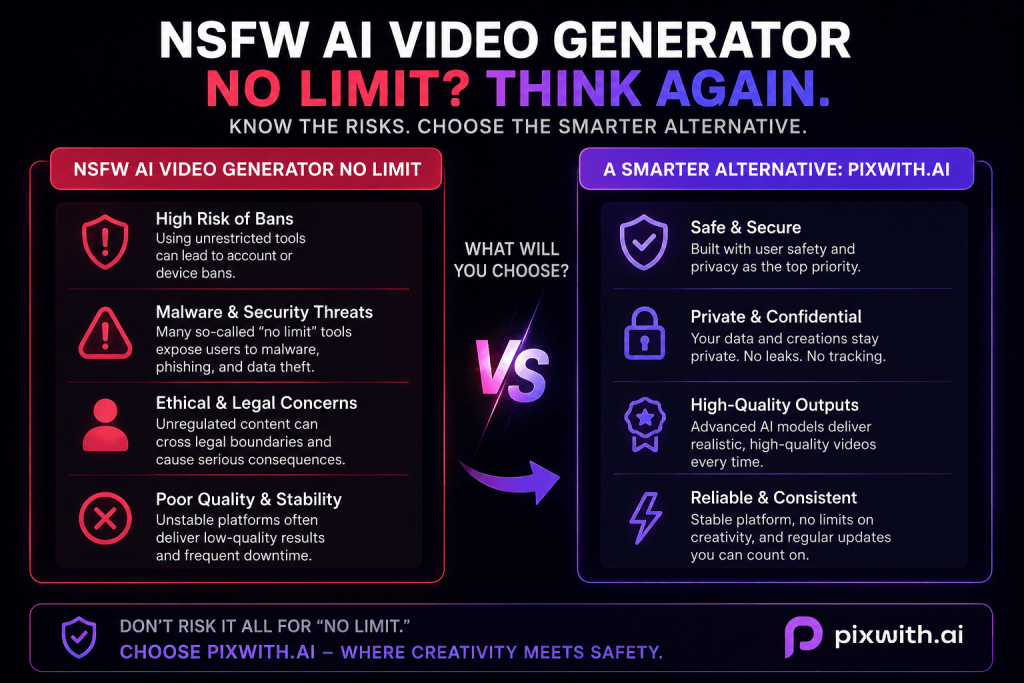
The Myth of “Unlimited” AI Video Generation
The idea of “unlimited” generation is one of the most misleading claims in the AI tool ecosystem today. While it sounds straightforward, in practice it rarely reflects actual system behavior.
Most platforms cannot physically support unlimited generation because every request requires significant GPU processing power, memory allocation, and server coordination. As a result, what users experience as “unlimited access” is usually a carefully controlled system disguised under marketing language.
In real-world usage, limitations begin to surface gradually. At first, everything appears smooth — fast rendering, decent quality, and responsive generation. But as usage increases, hidden constraints begin to activate without clear warning.
These constraints are not always openly communicated, but they significantly shape the user experience.
Common hidden limitations users encounter
- Soft usage caps that are not clearly disclosed
Many platforms quietly limit the number of generations per hour or per day. These limits are often flexible but still enforced behind the scenes. - Queue-based processing delays during peak load
When server demand increases, free or lower-priority users are pushed into slower rendering queues. This creates unpredictable wait times. - Adaptive quality reduction under system load
Some systems automatically reduce resolution or simplify output complexity when infrastructure is stressed. - Sudden friction points in workflow continuity
Users may encounter unexpected pauses, upgrade prompts, or partial generation failures mid-session.
Each of these limitations directly impacts creative flow, even if the platform continues to present itself as “unlimited.”
Why AI Video Generation Is Inherently Difficult
To understand why these tools struggle, it is important to look at the complexity of AI video generation itself. Unlike static image generation, video introduces time as a structural dimension, which significantly increases computational and modeling difficulty.
Every second of AI-generated video is not a single output — it is a sequence of interconnected frames that must remain consistent in motion, structure, lighting, and identity. This creates a compounding challenge for AI systems.
Even advanced models face difficulty maintaining stability across sequences. Small inconsistencies in one frame can quickly multiply into visible distortions over time.
Core technical challenges behind AI video systems
- Frame-to-frame consistency requirements
Each frame must logically connect to the previous one without breaking visual continuity. - High computational cost per generation
Video requires significantly more GPU processing than images, often scaling exponentially with duration. - Temporal motion instability
Maintaining natural movement across frames is one of the hardest problems in generative AI. - Identity drift across sequences
Characters or objects may subtly change appearance, leading to inconsistency in longer clips.
These limitations are not bugs — they are structural challenges in how current AI video models are built.
Why NSFW AI Video Tools Face Even Greater Constraints
When AI video systems are applied to NSFW or adult-oriented content, the complexity increases further. Even when platforms claim to be unrestricted, multiple layers of control often still exist within the system.
This is not only a technical issue but also a compliance and infrastructure challenge.
Many models are trained on datasets that intentionally avoid explicit adult content due to legal and ethical, and licensing restrictions. As a result, these systems are not optimized for highly specific NSFW generation tasks.
Additionally, moderation layers are often embedded at different stages of processing, sometimes affecting output without the user realizing it.
Key limitations specific to NSFW AI video tools
- Restricted training data availability
Models often lack sufficient real-world examples of adult motion dynamics, limiting realism. - Invisible moderation and filtering systems
Content filters may alter or suppress outputs without explicit notification. - Over-sanitization of generated visuals
Systems may unintentionally soften or blur details to avoid policy conflicts.
These constraints collectively reduce realism and consistency, even in tools marketed as “unrestricted.”
The Economics Behind “Unlimited” Claims
Beyond technical limitations, there is also a strong economic reason why truly unlimited AI generation does not exist.
AI video generation is extremely expensive to operate at scale. Each request consumes GPU time, memory, bandwidth, and storage resources. When multiplied across thousands of users, these costs become substantial.
Because of this, most platforms must carefully balance user access with infrastructure sustainability.
In practice, “unlimited” often refers to unrestricted access logic, not unlimited compute availability.
Why platforms still use “unlimited” marketing
- It attracts more users during early adoption phases
- It increases engagement and trial usage
- It creates perceived value compared to capped systems
However, once usage increases, backend limitations naturally surface.
What actually happens behind the scenes
- GPU resources are dynamically allocated
- User requests are prioritized based on subscription tiers
- System load balancing introduces delays and throttling
This means the user experience is always controlled, even when it appears open-ended.
Where Most Users Experience Failure in Real Workflows
The biggest gap between expectation and reality becomes visible when users move beyond testing and into actual workflow creation.
Initially, users often experience successful generations, which builds confidence in the tool. However, as they attempt more complex or repeated generations, the system begins to show instability.
Over time, the workflow becomes less about creation and more about troubleshooting.
The most common breakdown points include inconsistent output quality, unpredictable rendering times, and sudden limitations that interrupt ongoing work.
These issues make it difficult to build reliable production pipelines using a single “unlimited” tool.
Why Unlimited Tools Often Reduce Productivity
While unlimited access sounds beneficial, it often creates hidden inefficiencies in real production environments.
When outputs are inconsistent, creators must repeatedly regenerate content, adjust prompts control, and attempt workarounds. This introduces unnecessary time overhead.
Instead of focusing on creative direction, users spend more time managing system behavior.
Practical productivity issues caused by unstable tools
- Time lost in repeated generation cycles
- Difficulty maintaining consistent character identity
- Interruptions due to unexpected limitations
- Unpredictable output quality across sessions
In many cases, structured limitations actually improve productivity by enforcing predictable behavior.
A More Practical Approach: Structured AI Video Workflows (and Why They Work Better)
Rather than relying on a single “unlimited generator,” experienced creators are increasingly moving toward structured AI video workflows that break production into controlled stages. This shift comes from real-world usage: when everything is generated in one step, results often become inconsistent, difficult to refine, and nearly impossible to reproduce reliably.
The key idea is simple — instead of forcing AI to handle everything at once, creators guide it step by step. This reduces randomness, improves stability, and makes the entire creative process more predictable.
At a technical level, AI video systems perform better when tasks are broken down. Smaller, focused generation steps allow the model to maintain consistency, while large one-shot generations tend to accumulate errors across frames.
A More Reliable Workflow Structure
A structured workflow divides video creation into clear production stages. Each stage has a specific purpose and builds on the previous one, creating a more stable pipeline.
1. Concept and image generation phase
This is where the foundation of the entire video is created. Instead of jumping straight into motion, creators first define the visual identity using static images or keyframes.
- Establishes character identity and appearance
- Defines environment, lighting, and visual tone
- Creates a stable reference for later stages
This step is critical because AI video models rely heavily on visual anchors. Without a strong foundation, consistency tends to break during motion generation.
2. Motion development phase
Once the visual direction is locked, the next step is introducing movement. Instead of generating long sequences at once, creators work in smaller, controlled segments.
- Converts static visuals into animated sequences
- Focuses on short, manageable clips instead of full videos
- Reduces motion inconsistencies and frame drift
This approach allows creators to correct issues early rather than dealing with large-scale errors after full generation.
3. Refinement and stabilization phase
Raw AI outputs are rarely production-ready. This stage is where quality is improved and visual consistency is reinforced.
- Smooths motion transitions between frames
- Fixes visual artifacts and distortions
- Improves lighting and continuity across scenes
By treating refinement as a separate step, creators ensure that quality control is intentional rather than accidental.
4. Assembly phase
The final stage is where everything comes together into a complete video structure. Instead of relying on a single generation, creators build the final output from multiple refined segments.
- Combines clips into longer sequences
- Enables flexible editing and rearrangement
- Supports storytelling and structured pacing
This modular approach makes it easier to scale content production without starting from scratch each time.
Why Structured AI Video Workflows Perform Better in Practice
As AI video tools evolve, one clear pattern has emerged: single-step “all-in-one” generation rarely produces stable or repeatable results. While it may seem faster, it introduces unpredictable behavior that becomes more noticeable in complex projects.
Structured workflows perform better because they align with how AI models actually function. These systems are more stable when given incremental guidance rather than being forced to generate complete outputs in one pass.
This is not about limiting creativity — it is about controlling variability.
When everything happens in one generation loop, small inconsistencies can quickly multiply across frames. But when the process is divided into stages, each part becomes easier to manage and refine independently.
Key advantages of structured workflows
- Improved consistency across outputs
Breaking the process into stages reduces visual drift and maintains identity stability. - Easier error correction
Issues can be fixed at the stage where they occur instead of after full generation. - More predictable production flow
Each step behaves consistently, making planning and iteration easier. - Better scalability for longer projects
Modular outputs can be reused, extended, or replaced without restarting the entire process.
Why this approach matters
In practice, structured workflows transform AI video generation from a trial-and-error process into a repeatable production system. Instead of relying on luck or multiple regeneration attempts, creators gain a controlled environment where results are progressively refined.
The biggest advantage is not just quality — it is repeatability. Once a structured workflow is established, creators can consistently produce stable outputs, refine creative direction over time, and scale production without losing control over consistency.

Why Pixwith.ai Fits a More Realistic Creative Workflow
Rather than positioning itself as an “unlimited NSFW generator,” Pixwith ai aligns more closely with how creators actually work in practice: iterative, structured, and refinement-driven.
The focus is not on removing every constraint, but on making outputs predictable enough to build reliable workflows around them.
In practical terms, this means:
- More stable generation behavior across multiple iterations
- Better continuity between visual and motion stages
- A workflow structure that supports gradual refinement
- Reduced randomness in output results
For digital artists and technical creators, this shift matters. It turns AI video generation from an experimental tool into a usable production system.
Why Stability Matters More Than Unlimited Access
One of the biggest misconceptions in the current AI generation landscape is the assumption that more freedom automatically leads to better creative outcomes. In reality, the opposite is often true in production environments. Unlimited access without stability tends to introduce unpredictability, which can significantly slow down workflow efficiency.
When a system is unstable, every generation becomes a potential point of failure. Users are forced to constantly adjust prompts, retry outputs, and compensate for inconsistencies. Over time, this creates a cycle where the majority of effort is spent managing the tool rather than producing actual content.
Stability, on the other hand, changes the nature of the workflow entirely. When outputs behave consistently, creators can build structured pipelines around them. This allows for planning, iteration, and scaling — all of which are essential for professional-level production.
A stable system also improves creative decision-making. Instead of guessing whether the next generation will behave differently, users can focus on refining artistic direction. This leads to better long-term results because creative energy is spent on improvement rather than correction.
Another important factor is scalability. In real production environments, consistency is what allows projects to grow. Whether creating multiple variations, extended sequences, or multi-part content, stable systems make it possible to maintain continuity without rebuilding the workflow each time.
In contrast, “unlimited” systems that lack stability often collapse under sustained use. While they may feel powerful during initial testing, their unpredictability becomes a bottleneck when used for serious or repeated creation tasks.
Ultimately, stability is what transforms AI tools from experimental platforms into usable production systems. Without it, even the most powerful generation engine becomes difficult to rely on. With it, creators gain the control needed to build consistent, scalable, and professional workflows.
Conclusion
The idea of “unlimited NSFW AI video generation” is appealing, but in practice, it rarely reflects how these systems actually work. Most platforms are constrained by technical limitations, infrastructure costs, and model design boundaries.
For creators, the real goal is not unlimited access — it is reliable performance.
Structured platforms like Pixwith.ai reflect a shift away from marketing-driven “no limit” promises toward stable, workflow-oriented AI generation systems.
In the end, the most effective creative environments are not the ones that remove all boundaries, but the ones that make output predictable, repeatable, and usable at scale.
That is where real production value begins.