
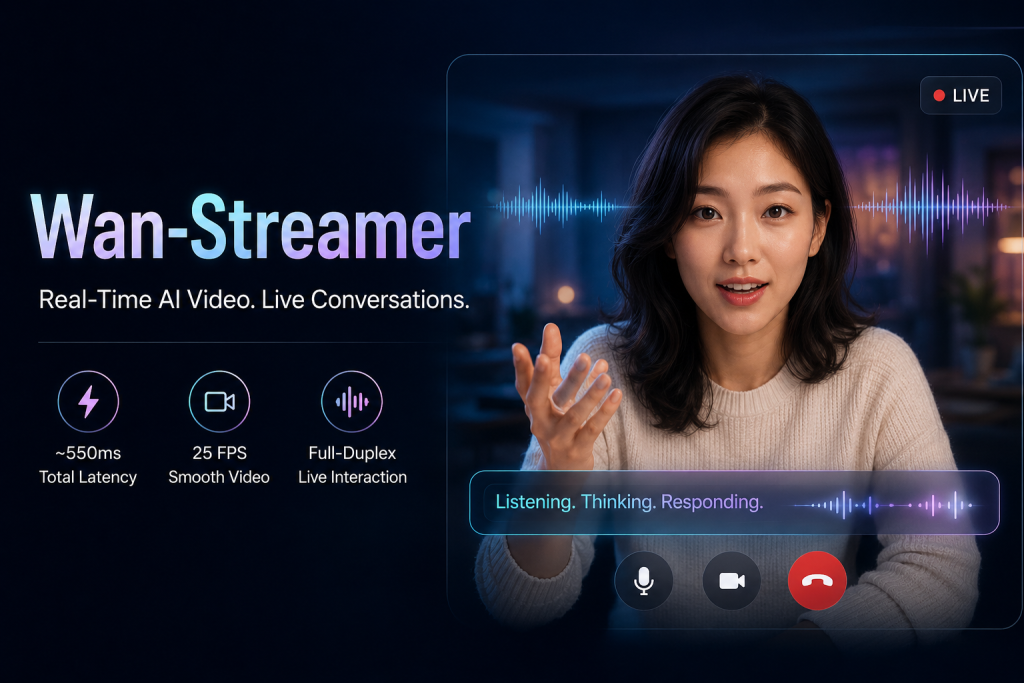
Most people who hear about a system that can look at you, listen to you, and talk back on video in under a second assume it’s a polished app they can download this weekend. Wan-Streamer isn’t that, at least not yet. It’s a research model from Alibaba’s Wan Team, and knowing the gap between the research and the product hype building up around it will save you a lot of confusion about what this technology actually does.
What Wan-Streamer Actually Is
Wan-Streamer is a foundation model created to support two-way, live audio-visual conversation. It’s a system that processes language, audio and video as input and output within a single neural network, not using separate tools for speech recognition, response generation and animation, the team that built it says. Version 0.1 was released in late June 2026 with a subsequent release, v0.2, shortly after which increased the output resolution without compromising the same response speeds.
That’s an distinction which should be sat with: Wan-Streamer is a paper and a demo, and never a actual products with a sign in page. The basic model itself has not yet been launched as a public-facing product, although some independent teams have begun to develop Waitlist products, offering features such as AI video companions or virtual hosts.
How It Works
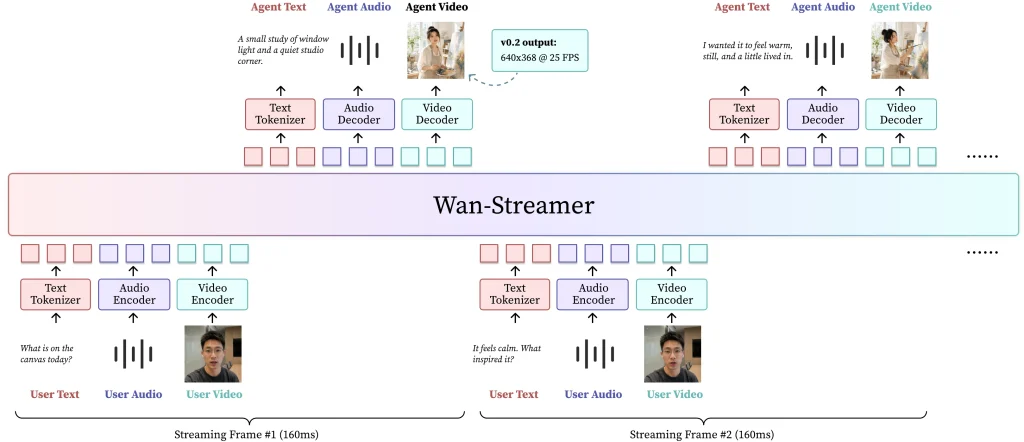
Older AI video assistants are designed on a relay basis. You speak into a voice-to-text device, which is then fed into a language model that produces a response, which then is translated back to speech and then fed into an animation system that animates a face to match the speech. The more hands that pass, the more delay and the more steps that take place the more the errors will be added on and compounded until a response is received.
Wan-Streamer skips the relay entirely. Here’s the basic sequence of what happens when you talk to it:
- Your voice and video feed into the model continuously, not in one finished chunk at a time
- A single transformer reads interleaved streams of visual, audio, and text tokens using block-causal attention, so it can react before you’ve even finished speaking
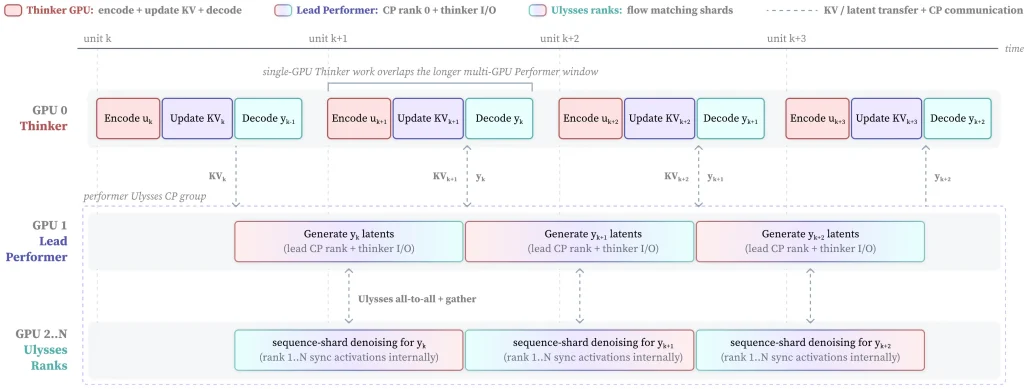
- A fast component, the “Thinker,” handles perception and decides what to say next
- A separate component, the “Performer,” handles the heavier job of generating matching video
- Both run in parallel, then their output is stitched back together and sent to you as synchronized audio and video
This setup is what lets the model notice you cutting in mid-response and adjust naturally, instead of freezing or talking over you.
The numbers back up the design choice. Wan-Streamer runs at 25 frames per second with roughly 200 milliseconds of processing time on the model’s end. Add typical network delay and the full exchange, from you finishing a sentence to seeing and hearing a reaction, lands around half a second. That’s fast enough to feel like a live video call rather than a chatbot with a face attached.
| Release | v0.1 (June 2026) | v0.2 (recent) |
| Output resolution | 192p (proof of concept) | 640 x 368 at 25 fps |
| Model-side latency | ~200 ms | ~200 ms (unchanged) |
| Total interaction latency (with network) | ~550 ms | ~550 ms |
| Focus | Establishing the native-streaming architecture | Raising video quality without losing speed |
What Makes This Different From Existing AI Avatars
There’s no shortage of AI avatar tools on the market already, so it’s fair to ask what’s actually new here. Most existing systems, even convincing-looking ones, are only rendering a face on top of a response that came from somewhere else. Their speed gets measured starting from the moment a script or audio clip is ready, not from the moment you actually said something. Wan-Streamer’s latency numbers cover the whole loop: hearing you, understanding you, and generating a synchronized video response, all in one system. That full-duplex quality, where the model keeps listening while it’s still responding, is the part that’s genuinely hard to fake with a bolted-together pipeline.

Where Real-Time AI Video Agents Could Be Used
Since this is still a research release rather than a shipped product, everything below is a plausible direction rather than something available today. Still, the shape of the technology points at a few clear areas:
- Customer service and support: a live agent that keeps eye contact and reacts without an awkward pause could replace the current mix of chatbots and phone trees
- Education and tutoring: language practice in particular depends on tone, timing, and facial feedback, so a model with natural back-and-forth timing opens the door to tutoring tools that feel closer to a real conversation partner
- Livestreaming and content creation: a few early-stage products are already building toward turning a conversation with an AI into short clips for platforms like TikTok or Instagram Reels
- Companionship and coaching apps: several prelaunch products are building toward this directly, offering an AI presence for casual conversation, check-ins, or roleplay practice
- Virtual onboarding and concierge tools: businesses relying on static FAQ pages or scripted chat widgets could offer a video-based guide that adapts to what a visitor is actually asking
The Part Worth Taking Seriously
The same traits that make Wan-Streamer useful, quick responses and a convincing on-camera presence, also make it a real security concern. Researchers have already pointed out that real-time, full-duplex video generation changes the math around impersonation. The old advice for spotting a deepfake on a live call, things like asking someone to turn their head or hold up a hand, assumes a delay or a glitch that this kind of system is specifically built to remove. Anyone building on this technology, or any business that handles sensitive requests over video calls, should be thinking now about verification methods that don’t depend on “does this look real,” since that test is quickly losing its usefulness.
Where This Leaves Things
Wan-Streamer takes a genuinely different approach to real-time AI video, and the latency and synchronization numbers back up the claim that it’s solving a real technical problem rather than producing a flashier demo. But it’s still a research model at an early version number, not a finished product available for purchase. The waitlist products showing up around it are a signal of where things are headed, not proof that the experience is ready for everyday use. If you’re weighing this space for a business case, keep an eye on the next couple of version releases, since the jump from v0.1 to v0.2 happened fast, and treat any product built on top of it as early-stage until it proves otherwise.