
AI image-to-video generators have become an asset to social media content creators because short-form videos stop the scroll, hold viewers’ attention, and drive engagement on social media platforms. Moreover, image composition and aesthetics alone are no longer enough to compete in feeds that are dominated by a continuous stream of autoplay videos.
Some generators also impose limits (e.g., watermarks, login walls, generation caps, or restricted prompt control) that slow down content production and reduce creative flexibility. However, no-restriction AI image-to-video generators remove friction from the workflow, allowing creators to produce publish-ready content.
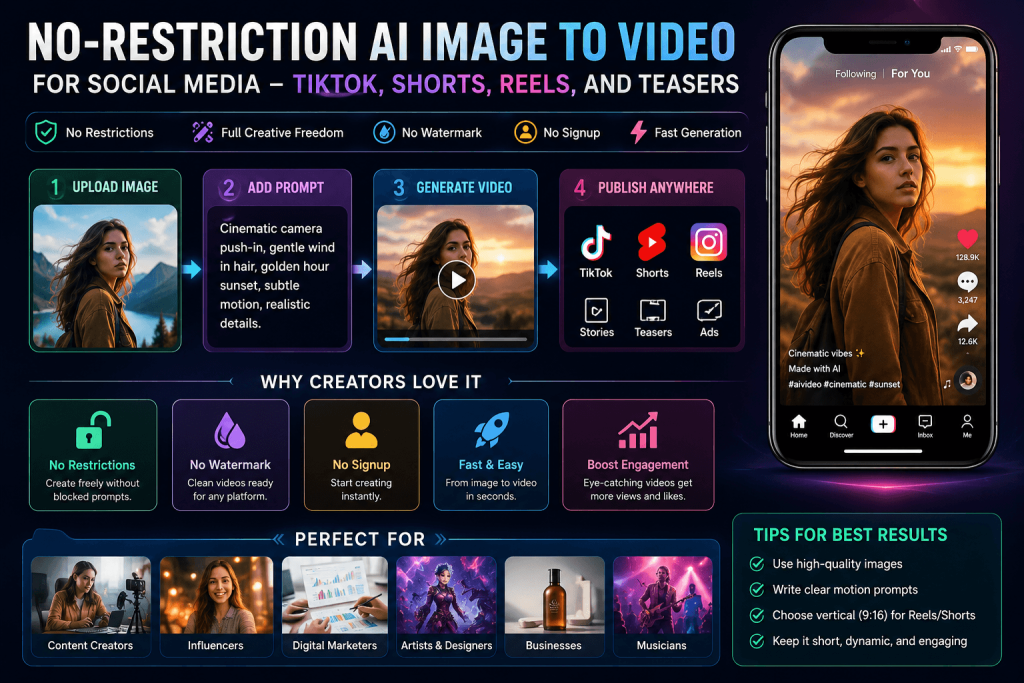
Why Still Images Underperform (and Where Motion Wins)
Modern social platforms judge content in motion and in context. Even so, on TikTok, Shorts, or Reels, where the content is on autoplay, a still image is at a disadvantage because it “requires” attention while a video “captures” it.
Fundamentally, static graphics underperform because they depend on the user’s choice to stop, interpret, and engage. However, in fast-scrolling feeds, there is no pause for interpretation because the brain is continuously scanning for changes in lighting, motion, contrast, or anything that signals “this is different.” Therefore, a high-quality image that leaves no impression will vanish into the flow of content, unnoticed.
In contrast, the smallest animation creates a visual interruption that gives the brain a reason to pause, even if only for a second. And that second is everything because once the scroll stops, the platform registers interest, and the content is given a chance to perform.
Moreover, the motion does not need to be complex to be effective. In fact, overly complex animation usually works against performance. Simple and controlled motion, however, communicates quickly, holds attention just long enough, and encourages the viewer to keep watching, or even watch again.
In addition, social platforms heavily reward content that seamlessly repeats — loopability. A short clip that loops without a noticeable reset can generate multiple views from a single impression, increase watch time (through continuous viewing cycles), and boost the overall performance metrics. Still images cannot do this.
Ultimately, users consume content quickly, passively, and visually. In AI image-to-video generation, the image remains the foundation, but motion gives it the ability to compete, to be seen, and to perform.
What “No Restrictions” Enables in Social Media Workflows
Trends change daily, formats evolve constantly, and what performs today may be irrelevant tomorrow. Therefore, social content creators are continuously testing, adapting, and iterating. And restrictions, in the form of forced logins, limited generations, watermarks, or prompt rewriting, break that creative loop.
“No restrictions” is an advantage in social media workflows because when there are no barriers between idea and output, creators can move at the pace that social platforms demand. They can take an image, generate multiple variations, tweak motion directions, adjust tone, and see what works. There is no waiting, no friction, and no disruption to momentum.
Moreover, some AI image-to-video generators attempt to “help” by simplifying or rewriting prompts. Precision matters in social media content, so when prompts are restricted or modified, control is lost. No-restriction generators, however, preserve intent and allow creators to design specific hooks, subtle motion cues, and exact visual behaviours for their content strategy — prompt control.
In addition, watermarks and usage limitations may seem minor, but they add unnecessary extra steps in a publishing workflow. Removing those constraints means the outputs will be in a publish-ready state — output readiness.
Nevertheless, social media success is rarely about getting one perfect video. Therefore, creators can test different hooks from the same image, scale their content, and refine their approach. In practical terms, No-Restriction AI video creators are no longer limited to a single output per idea. One image can produce several distinct clips, each targeting a different angle (e.g., emotion, pacing, visual emphasis, or narrative).
Taken together, “no restriction” supports rapid experimentation, precise creative direction, and efficient publishing, and also sustains consistent performance.
Designing Hook-First Image-to-Video Content
The first frame is everything on social media. Before the motion even has time to play out, the viewer has already made a decision, consciously or not, about whether to keep watching or keep scrolling. The concept of “hook-first” content is so critical in image-to-video workflows because the image you start with will determine whether your video gets a chance to perform at all.
Clarity and curiosity are the reasons users stop to consume content. A hook image must communicate intent, pique the viewer’s interest, or pull them in somehow. This could be an expressive face, a dramatic contrast in lighting, an unusual composition, or a visually striking subject. The key is for the viewer to understand what they are looking at within a split second, and be compelled enough to keep watching.
More so, transforming an image into a video should amplify the hook, not change it. Motion should reinforce what made the image effective in the first place. If the hook is emotional, the motion might be a subtle shift in expression or eye movement. If it is a visual contrast, the movement could be a slow reveal through lighting or a gentle camera push.
Image-to-video AI for Shorts, Reels, and TikTok also has the ability to turn one hook into multiple variations. The same base image can generate different interpretations, and each variation becomes a separate opportunity to capture attention, even though they all originate from the same graphic.
Overall, the image is the hook, and motion is the amplifier. When both are done right, a simple concept can outperform a more complex content with its first frame.
Best Motion Styles for TikTok, Shorts, and Reels
Effective motion styles are usually emotionally intuitive (e.g., subtle motion and micro-movements).
Even so, camera movement plays a significant role in maintaining stability. A slow push-in, a minimal pan, or a controlled zoom can add depth and cinematic quality without distorting the subject. By moving the “viewer” instead of the subject, creators get to preserve the visual integrity of the character.
It is also worth noting that the best-performing clips are those that do not seem to have a beginning or an end — loopability. They flow continuously, replay seamlessly, and encourage multiple viewings without the viewer consciously realizing it. This directly increases watch time, which is one of the most important signals for platform algorithms.
Moreover, it is better to introduce less motion than to have too many elements moving at once because excessive information can lead to cognitive overload and viewer disengagement.
Whether it is a soft cinematic zoom for Shorts, a subtle emotional cue for TikTok, or a polished aesthetic movement for Reels, the most effective animations are natural, intentional, and easy to understand at a glance.
Creating Vertical, Loopable, and Mobile-First Outputs
Short-form content is designed for the mobile screen, and that affects framing and optimization. Unlike traditional video formats, where viewers sit back and watch, social media content is consumed in motion and on small screens; therefore, vertical, loopable, and mobile-first outputs are foundational to performance, not optional.
The 9:16 aspect ratio (i.e., vertical framing) is the default for TikTok, Shorts, and Reels. It fills the entire screen and maximizes visual impact. More so, the subjects are positioned at the center to avoid risks of being cut off by interface elements (e.g., captions, buttons, or overlays).
Designing for mobile also means prioritizing clarity over detail because intricate visuals can become noise on a small screen. That said, a strong contrast, defined subjects, and clean compositions perform better and are readable even on smaller displays.
In addition, a mobile-first design is also a performance advantage, thanks to loopability. A seamless loop removes the concept of a beginning and an end, allowing the video to replay continuously without interruption. When done correctly, the viewer might not even realize that the video has restarted. And an increase in watch time can significantly boost visibility.
Duration is just as important because most high-performing image-to-video clips for social media usually fall within a short range, often just a few seconds long. This is an advantage since short clips load quickly, loop easily, and fit perfectly into a fast-scrolling user experience.
In essence, creating mobile-first outputs is about designing the AI image-to-video outputs for a vertical, fast-paced, and attention-driven experience.
From One Image to Multiple Posts: Repurposing & Batch Testing
Performance is unpredictable in short-form content. Therefore, successful creators rely on variations.
A single image can be the foundation for an entire batch of content, as creators can produce multiple versions of it to explore different angles. By releasing multiple variations, one version might hold attention longer, and another might loop more smoothly, and these small differences can lead to massive performance gaps based on engagement signals — batch testing.
Moreover, instead of spending time perfecting a single clip, creators can generate multiple variations and publish them within a short window to increase their chances of catching momentum while a topic, format, or style is still relevant and trending. Speed matters, but speed without variation is risky.
Repurposing also makes it possible to distribute the same set of generated clips across TikTok, Shorts, and Reels with minimal adjustments. Their performances may vary with each platform, but the core content will be effective nonetheless.
Ultimately, this workflow is feasible and smooth because of “no restrictions.” Creators are no longer limited by generation caps, watermarks, or prompt constraints, and they can iterate based on performance data (i.e., a feedback loop that improves long-term results).
Publishing Workflow: From Generation to Viral-Ready Clip
Timing, consistency, and execution matter just as much as creativity in AI image-to-video generation for social media.
The starting image must have a hook potential. Once that image is converted into motion using an AI image-to-video generator, the next step is to refine the raw output and trim, if necessary. Then loop the video, for longer watch times.
Creators can also add text overlays and audio for enhancement. Text overlays are secondary hooks that adds context to the video. Similarly, audio, whether it is a trending sound or some background music, makes the AI video more immersive.
Creators must export the video in a vertical format for publishing, while the performance metrics provide insight and feedback.
In practice, creators get to generate, refine, and publish content at a fast and consistent pace.
Takeaway
In real use, no restrictions, faster generation, and cleaner outputs do not automatically translate into performance in AI image-to-video for social media. It comes down to how effectively the content can earn/capture attention and sustain engagement.
Across TikTok, Shorts, and Reels, the videos that perform best always start with a strong visual hook and use motion to reinforce that hook.