
For anime, fantasy, and character artists, AI image-to-video generation promises to bring their artwork to life. In practice, however, the output rarely looks like their art anymore, and what should have been an extension of the original artwork often turns out to be strange, unstable, generic, or overly “realistic.”
“No restrictions,” in this context, is about removing interference that simplifies artistic direction, because these constraints strip away style, flatten creativity, and make different artworks look the same — undermining style integrity and the preservation of artistry.
Anime, fantasy, and character art need more precision and creative control, not automation.
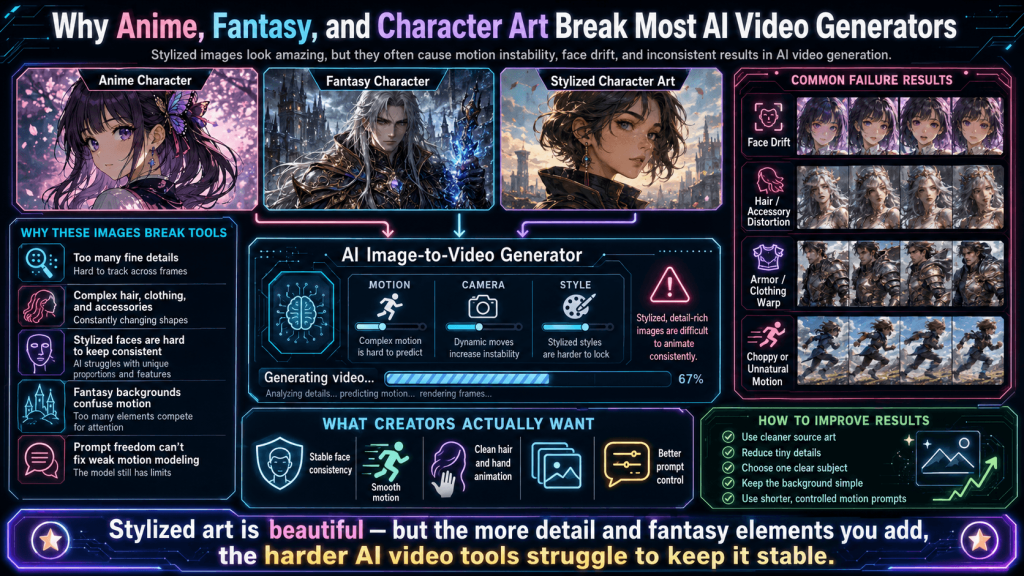
Why Anime, Fantasy, and Character Art Break Most AI Video Generators
Most AI image-to-video generators are built for the real world. More so, their training data, motion assumptions, and visual priorities are heavily biased toward photorealistic imagery. This works well for landscapes, real people, and everyday scenes, but it is a fundamental mismatch to anime, fantasy, and character-based artwork.
Anime relies on simplified yet precise linework, exaggerated proportions, and symbolic expressions. Fantasy art usually introduces elements that do not obey physical laws (e.g., glowing magic, floating particles, or shifting energy forms). Character art (in concept design), however, prioritizes identity, silhouette, and detail consistency over natural motion. Therefore, AI models trained on realism will most likely attempt to “correct” them, unintentionally.
By implication, some anime outputs frequently drift toward realism because the generator interprets it through a lens it understands. But in doing so, it erases the very qualities that define anime artwork.
Moreover, effects like glow, fire, or magical auras, in fantasy art, are inherently unstable because they do not exist in a real-world form. And in restricted workflows, these elements might flicker, fade, or be inconsistent across frames.
The challenge of character art is identity consistency — even the slightest change in facial structure, eye placement, or costume detail can break the illusion of the character.
Taken together, standard AI image-to-video generators are optimized to simplify, normalize, and generalize visual input to produce realistic results. However, stylized art requires the opposite. It demands precision, intentionality, and the preservation of artistry.
What “No Restrictions” Actually Means for Style Control
In the context of anime, fantasy, and character art, “no restrictions” has to do with/is about retaining full control over the stylized artwork’s interpretation and animation.
Occasionally, stylistic prompts may be simplified, rewritten, or reduced to generic interpretations, and the system may dilute the details in favour of what it considers more stable or realistic. “No restrictions,” in a practical sense, removes interference, preserves the nuance of prompt instructions, and allows creators to specify stylized motion.
This degree of control directly influences visual consistency. Because when style descriptors are preserved, the linework will stay clean, the colours will remain cohesive, the rendering styles will be uniform across frames, and the output will be a continuation of the original piece.
“No restriction” enables a more complex creative direction. More so, fantasy scenes with layered effects, character-focused animations with subtle emotional expression, or stylized environments with atmospheric motion all require precise instructions. And without restrictions, those instructions will be executed with greater fidelity.
Ultimately, “no restrictions” improves precision and preserves uniqueness (in anime, fantasy, and character art) for creators working in highly stylized domains.
Directing Motion in Stylized Content (Without Breaking the Scene)
Motion, in anime and fantasy art, must be controlled and intentional to maintain the illusion of the style. Aggressive or random movement breaks the illusion.
In stylized art, movement is often suggested rather than fully expressed. This implies that a blink, a smooth change of posture, or a gentle movement of hair can be more convincing than some exaggerated action. Even so, some anime AI image-to-video generators “overcompensate” when they are given motion instructions (prompts) that are vague or overly ambitious, thereby causing jittery movement, warped features, or unnatural transitions between frames.
In addition, small and focused actions in anime-style content (e.g., a slow blink, minimal breathing motion, or a slight head tilt) are far more stable because the AI gets a clear and limited task. Moreover, the elements (e.g., hair and clothing) can also simulate motion without affecting the core identity of the character.
Fantasy content takes a similar approach but with different visual elements. Instead of facial micro-movements, it emphasizes environmental and effect-based motion (i.e., cloaks can move with implied wind, magical auras can pulse softly, and particles like sparks or light can drift through the scene). These elements simulate motion without altering the character’s structure. However, they cannot be too intense; they must be controlled.
Nevertheless, stylized motion can be challenging because of its smaller margin for error. Imperfections can sometimes go unnoticed in realistic scenes, but in anime and fantasy art, the slight distortions in linework, proportions, or effects are almost impossible to miss.
In stylized content generation, creators must always focus on producing subtle and meaningful movement and also avoid unnecessary complexity to maintain stability and improve usability.
Less motion does not mean less impact. It often means more control, more consistency, and better results.
Camera Control: The Secret to Stable Anime and Fantasy Videos
Camera control is a remarkable technique in AI image-to-video generation, as well as in stylized themes, because it significantly improves consistency, reduces distortion, and preserves the original art style.
In real use, character motion in anime and detailed fantasy art requires the AI to reinterpret the structure frame by frame. Even small movements can introduce changes in linework, proportions, or facial features, and these changes can accumulate into visible warping or identity drift. Camera motion, on the other hand, does not require the model to rebuild the subject. It only changes the viewer’s perspective of an already stable scene.
A slow push-in, for example, creates a cinematic sense of movement without altering the character’s structure (i.e., the face, linework, and proportions remain intact). This is effective for portraits and character-focused scenes, where it is critical to maintain identity.
Similarly, panning (i.e., changes in viewpoints) can also add depth to fantasy scenes. More so, a change in perspective for the background layers, lighting, and atmospheric effects can also enhance immersion.
Nevertheless, static framing (i.e., keeping the camera stationary while introducing only micro-movements) produces very stable results. It also reinforces the notion that some scenes are better without dramatic motion.
In essence, camera control reduces the burden on the AI image-to-video generator.
How to Keep Character Identity Stable Across Frames
Identity drift is a major challenge in stylized AI image-to-video generation. Therefore, it is imperative to start with a clear and well-defined character image. The faces must be fully visible, and with detailed structure and clean linework. The more readable the face and form are, the easier it is for the AI to preserve them over time.
Moreover, radical and complex motion increases the chance of distortion. Whereas, subtle movements and minimal posture shifts do not require major reconstruction of facial or body features and, by implication, keep the character stable.
In addition, reinforcing key elements such as hairstyle, clothing, and overall style in prompt descriptions anchors the identity across frames, and it also reduces ambiguity. However, vague or inconsistent descriptions leave room for reinterpretation.
In stylized content generation, clarity and control preserve identity, and a stable identity is the foundation of believability.
Prompt Patterns for Anime, Fantasy, and Character Art
In stylized image-to-video generation, good prompting/prompt structure balances motion, style, and clarity.
For anime-style motion, a prompt that describes gentle blinking, slight breathing, or soft hair movement gives the AI anime image-to-video generator a narrow scope to work within. More so, it reduces the need for structural reinterpretation and helps preserve linework and facial consistency. Basically, keeping the motion minimal ensures that the character remains stable.
In contrast, fantasy prompts emphasize environmental and effect-based motion rather than the character’s movement (e.g., glowing aura, drifting particles, or a slow pulse of magical energy). Basically, the elements simulate motion and add depth to the animation while the character remains unchanged.
Moreover, instead of animating the character directly, the prompt can also describe a slow push-in, a gentle pan, or a subtle shift in perspective to create movement at the scene level rather than the subject level. This significantly improves stability and also adds a professional, film-like quality to the output.
For character-focused animations, however, stability comes from reinforcement and repetition. Therefore, creators must use consistent descriptors of the character’s appearance (e.g., hairstyle, outfit, and style type) to anchor its identity across frames. And combined with limited motion instructions, this approach ensures that the system prioritizes consistency over variation.
Taken together, these prompt patterns are effective because of their simplicity.
They define the direction, limit ambiguity, and maintain stylistic intent throughout the generation process.
Common Mistakes That Cause Warping in Stylized AI Video Generation
Unlike in realistic video generation, where an imperfection can sometimes go unnoticed, anime, fantasy, and character art expose every flaw. Small mistakes in direction, composition, or prompting don’t just reduce quality; they break the entire illusion.
Overloading the prompt with multiple actions is a common mistake. When the AI image-to-video generator is prompted to animate blinking, head movement, hair flow, lighting changes, and environmental effects all at once, the system might fail to execute correctly because of too many variables.
A more subtle but equally damaging mistake is failing to reinforce style in the prompt. When the style descriptors are missing or too vague, the AI defaults to what it knows best — semi-realistic rendering. Therefore, creators must actively maintain the style; otherwise, the artwork or character may gradually lose its original artistic identity.
Furthermore, most generators are incapable of sustaining dramatic effects, motion, and transformations across panels.
Ultimately, by simplifying prompts, reducing visual noise, reinforcing style, and focusing on subtle, intentional motion, these mistakes can be avoided.
In stylized themes where precision is essential, the solution is better direction.
Bottom Line
“No restrictions video generator” in anime, fantasy, and character art gives creators a direct line between their idea and the output — it removes interference. However, it takes clarity of vision, restraint in execution, and consistency in direction to transform that freedom into consistency, reliability, and usability.
Subtle motion always outperforms complex animation. Controlled camera movement often delivers more stability than forcing the subject to move. Reinforcing style consistently produces better results than assuming the model will preserve it automatically.
The goal is not just to animate stylized art. It is to protect it, extend it, and bring it to life without losing the qualities/features that made it unique.