
AI image-to-video tools have become a major part of modern digital content creation. Apart from the fact that the tools make users turn a single image into a short animated video within seconds, they also help give the subtle feeling of a working partner to users.
However, as these tools become prominent, several issues have accompanied it. The biggest one is prompts getting blocked or altered without a clear explanation. Because of this, searches around AI image-to-video content filters have increased as users have become frustrated with how these moderation systems work in practice. They are trying to come up with what could be the reason behind their consistent idea failure in practice and why a prompt gives different results across tools.
In this post, we will share the cause of these issues, their impact on users, and some attributes a good tool should have.
What are AI image-to-video Content Filters?
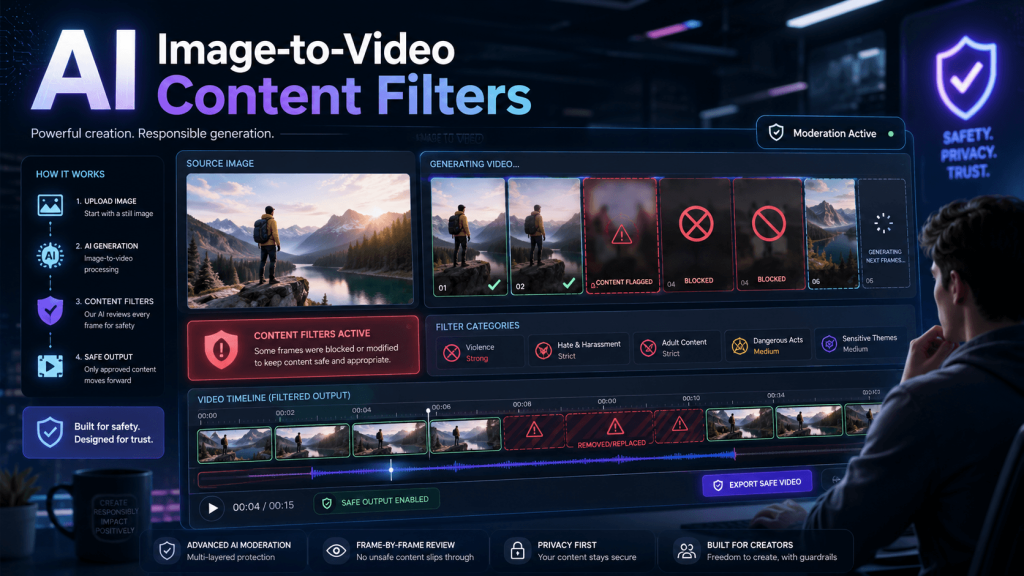
AI image-to-video content filters are simply intermediary systems between the user’s prompt and the generated video. Their purpose is to moderate or evaluate what users request before delivering it for generation. These systems depend on a combination of automated systems, which include keyword detection, image recognition, and internal safety scoring models.
Moreover, when a prompt is flagged, these systems are also the ones that block the generation or cause modification to the outputs.
Theoretically, this is to ensure compliance and safety, and practically, it introduces unpredictability into an expected straightforward process.
Why Filters Feel Stricter Than They Should
One of the major reasons behind users’ frustration is the fact that AI most of the time doesn’t always comprehend their intent. One thing that is certain is that AI doesn’t interpret data as humans, but acts only on pattern recognition. Instead, the system evaluates signals in the prompt and assigns a risk level instead of understanding what a creator is trying to achieve. This usually leads to situations where:
- Creative or artistic ideas get flagged for unrelated reasons
- Stylized descriptions are treated too literally
- Harmless concepts are restricted because they resemble sensitive patterns
All these are viewed from the outside as inconsistencies, which quickly result in frustration because users are unsure of what works and what doesn’t.
False Positives in AI Image-to-Video Content Filters
One of the most frustrating issues these systems have is false positives. This is when a normal and harmless prompt gets restricted or blocked without any reasonable cause.
In real use, this can look like using a prompt that worked earlier again, and it suddenly doesn’t without any changes to such a prompt.
In this case, there is no reasonable explanation for this, and this causes users to continuously guess, and they keep changing these prompts without a clear understanding of what the cause might be.
All these then cause a reduction in creativity because users are already worried about “what might get blocked” instead of what they want to create.
Hidden Prompt Rewriting and Silent Adjustments
This is another hidden issue many users don’t immediately notice. Not all, but some AI image-to-video systems accept prompts but slightly adjust them behind the scenes. These can include:
- Certain descriptive words are being softened or removed
- Visual details are being simplified
- Stylistic direction being adjusted
- Motion intensity is being reduced
Even though users still get results, it always appears diluted or slightly different. Since these problems are not communicated, creators are often confused about what the outputs are and what they expect.
Why the Issue Is Worse in Video Than in Images
These said issues have appeared to be worse in videos than in images. Unlike videos, image generation is done instantly and can be iterated easily in case of a wrong generation.
However, in the case of video generation, the process takes longer, and iterating can be a hassle. Due to this, users are often faced with interruptions in creativity, which heavily impacts them as it is much harder to recover from compared to images.
The Hidden Impact on Creative Behavior
As a result of endless frustrations, user behaviors have been impacted when it comes to using the system. Instead of creating smoothly, they start to simplify prompts to avoid rejection, avoid more complex or experimental ideas, and stick to formats that reliably work.
Since the tool doesn’t fully stop creativity but slowly narrows it down by encouraging safer inputs, most users are impacted without noticing, as this shift happens gradually.
Why AI image-to-video Content Filters Vary across Platforms
Inconsistency between tools is another issue. There isn’t a universally agreed-upon level of strictness or leniency for filters. As a result, this creates completely different moderation outcomes between tools. One tool can detect a prompt and have no issues, while another can see the same prompt as an issue and completely block it.
Even the tools that are similar can have completely different moderation results. This is not the best for the creator since they now have to learn how each system can moderate, and it can be distracting when trying to create.
What Actually Matters When Choosing a Tool
After a creator gains enough experience with different tools, many of them start focusing on behaviors rather than features, and having a system that is more predictable is more important. To give a solution to this matter, here are some attributes of a good tool:
Predictability
This is a check to see if the system is completely consistent or random when it is used multiple times.
Prompt integrity
Also, check if the system is changing a prompt when it is not intended to be changed.
Transparency
A check to see if users are informed if a prompt is being modified or blocked.
Workflow stability
Also, check if a creator can do what is intended without being blocked or interrupted multiple times.
All these are more important than a system’s technical specifications. Hence, ensure you keep these criteria in mind when looking for a tool.
AI image-to-video Generator with Fewer Creative Barriers
Because of the frustration stemming from those tools, many creators are now focused on tools described as an AI image-to-video generator with fewer creative barriers. What they are really looking for is not just completely unrestricted tools. What they are looking for is more consistency where:
- There are not as many blocked prompts.
- There is consistency in outputs.
- Rewrites do not always occur.
- There are not as many disruptions to a creator’s workflow.
Ultimately, creators prefer systems that do not over-analyze every prompt.
Where Things are Heading
AI image-to-video tools are improving, but are becoming subject to more regulation as they develop. With the rapid development of these kinds of tools, companies are now required to abide by safety measures and laws, as well as control potential backlash from the public regarding their AI tools.
This results in more stringent moderation standards that are becoming the norm in the industry.
The goal for the future is not removing filters. The goal is to apply filters that are as accurate and as transparent as possible and to lessen the negative impact on true creative effort.
Conclusion
The primary problem regarding the moderation of AI image-to-video content filters is not the moderation itself. The issue is primarily due to a lack of clarity and inconsistency.
This is where creators become frustrated. Rules are necessary and can be adapted by creators. However, unpredictability is not something that creators are able to adapt to, e.g., blocking prompts without any explanation or changing outputs without any notice.
When things start becoming so unpredictable, it is frustrating, and the creative process becomes so bloated that it starts to resemble a series of experiments.
When these types of things start to happen, users of these tools begin to seek out other tools that they think will be more grounded, more honest, and more in line with their desired outcomes.