
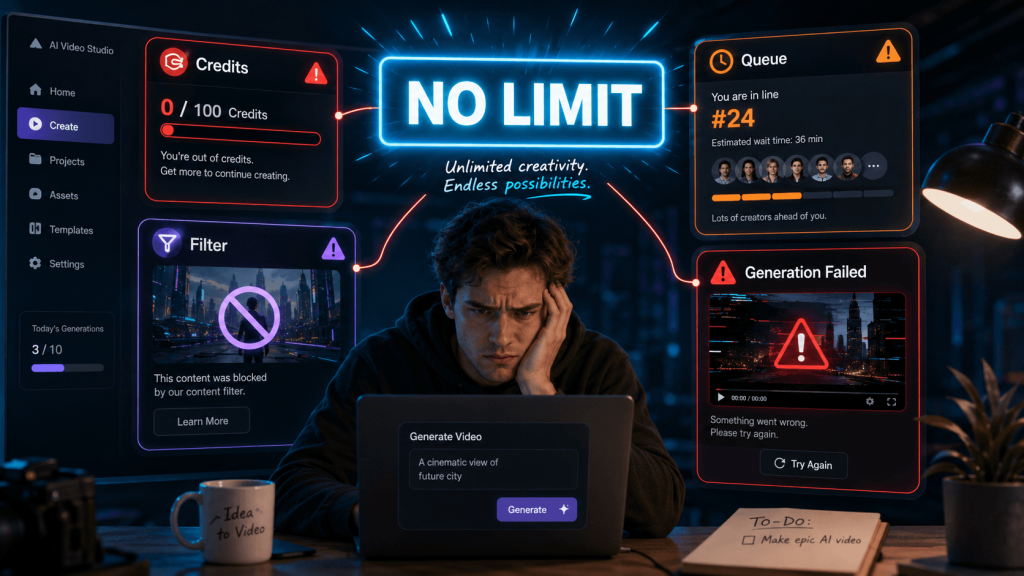
Today, most people claim that AI video generators have no limit in creativity and productivity. However, as a user who utilizes these tools repeatedly or constantly would understand that it is not so clear-cut . When you reach a stage, you attempt to create a video, but after a long wait, you receive an end product that is warped and ugly. So you try again. And again. Now your “unlimited” plan feels far from unlimited because of:
- Slow rendering queues
- Short clip limits
- Watermarks or restrictions on formats
- Failed generations that still cost credits
- Quality drops during peak hours
AI video generation is a costly undertaking, and this serves as the primary restriction.
Therefore, let’s break down every aspect regarding the hidden economics of AI video, including its limitations. Abide with us as we unravel the details.
The Hidden Cost Behind Every AI Video
Creating AI videos drains a ton of GPU computing power, a substantial amount compared to text generation.
This is why most platforms create videos with advanced AI requires powerful models that consider:
- Motion prediction,
- Temporal Rendering,
- Lighting Simulation,
- Upscaling, and
- Rendering
When trying to create videos in only 5–10 seconds. A huge amount of computing power is needed compared to text. Yet, retries drain the computation budget for the platform.
An AI video generator no credits is essentially a system that creates no credits for the platform because no credits exist. Thus, there is still usually a limitation in the algorithm.
Why “Unlimited” AI Video Plans Still Have Limits
1. GPU Queues
Similar to most AI video platforms, demand for our product correlates directly with subscription tiers. During peak demand periods:
- GPU demands from free users are fulfilled last
- GPU demands from “unlimited” users may not be fulfilled at all
- Video generations may take longer than usual
- Render quality may degrade
This is why some platforms spike from 30-second generation times to a 15+ minute average during peak periods.
2. Generating video fails with AI
This is the biggest frustration users often do not expect; AI generation of video is highly unstable. This can lead to frustrating issues like flickering faces, warped hands, disrupted continuity, camera drift, awkward misunderstanding of prompts, erratic scene changes, and inconsistency of characters.
Unlike the generation of images, AI errors in video generation build upon each previous frame. This leads users to require:
- 3 tries
- 5 tries
- or even 20+ tries
before being able to generate a video segment of any relative use. This is exactly the reason why “no limit AI video generator” or “unlimited AI video generator” searches are conducted. The goal of the searches is not to bend the rules, but rather to compensate for unpredictability.
3. “Unlimited” Means Something Else
A vast majority of platforms implement soft caps on their offerings despite listing an “unlimited” plan. These frequently include the following terms of “unlimited” video generation”:
- Daily generation caps
- Protection against GPU abuse
- Deprioritization within the GPU queues
- Slowed rendering speeds
- Lockouts
This is a common policy within the industry. After all, a tiny fraction of power users can generate a cost to a platform that overshadows any profit from their subscription.
4. Length of Video Clips Is Usually Limited
Another hidden restriction with most “unlimited” generators is that they only allow short outputs. The standard limits are:
- 3-second duration,
- 5-second duration,
- 10-second duration.
Even short videos may require credits or upgrades to longer tiers, plus several generated clips.
This results in several glitches occurring with every additional clipped video, such as:
- style inconsistency,
- jumpy motions,
- drifting video quality.
Additionally, “unlimited” generation does not equate to unlimited stories.
5. Quality Declines When System Is Overloaded
During peak usage, some systems decide to:
- reduce frame quality,
- lower rendering precision,
- apply a harsher compression,
- slow calculations and reasoning.
As a result, the videos appear:
- blurry,
- lose prompts and video portrayals,
- cause less stable movement,
- and exhibit more artifacts.
All of this requires more time to generate the video, as users have to retry the video numerous times due to:
- almost zero accuracy,
- poor portrayal,
- unstable movement,
- and a lot of artifacts.
The Real Issue Isn’t the Credits, It’s the Costs
How users define a good tool has changed. What users really want is a tool that provides more reliable outputs with predictable quality and less wasted time.
This means that one clean generation is more valuable to the user than 50 unusable ones.
Smart creators therefore prefer to use the tool that consistently produces usable results.
What Smart Creators Should Look For Instead
Chasing “unlimited” offers is futile. Smart Creators should select tools that deliver:
- Quality Output Predictability
Less redoing means more consistent motion and accuracy with prompts.
- Quick Iterations
Less queuing while maintaining fast rendering speed is worth more than potentially unlimited solutions.
- Reliable Character Development
Generation consistency means less editing.
- Transparent Limits
Platforms that communicate fairly do so about the rendering time, the queues, and the generation policies.
- Prompting Workflows That Enhance Efficiency
Tools that deliver results faster and therefore drive more efficiency.
The Economics of “AI Video Generator No Credits”
A platform offering:
- infinite generation
- infinite duration
- no queues
- high quality
- no cutbacks
would probably go out of business unless:
- The pricing was exorbitant
- The infrastructure was overly optimized
- The quality of AI video generation was excessively curtailed
- AI video computing technology has considerable costs.
This is why most platforms strike a balance between:
- the demand of the users
- the costs of the GPU
- the speed of rendering
- policies of fairness
- The economics of subscription services.
Final Thoughts
The absence of limits has risen because AI video often takes multiple tries before a satisfactory final product. However, every generation is expensive due to the consumption of a lot of GPU resources, rendering time, and infrastructure costs. That is why even the no limits AI video generator platforms still have:
- queues
- a cap on technology’s fair-use
- throttled generation
- restricted outputs
- hidden limits
The focus should not be on unrestricted generation. Instead, Smart Creators should look for platforms that deliver consistent quality, generation predictability, and less redoing to attain professional standards.
Instead of aiming for multiple generations, settle for a tool today built to avoid repetitive attempts. Adherence to prompts, stable rendering, and predictable quality will save more time and effort than anything that has an “unlimited” label.