
Every few months a new AI video model shows up with a demo reel that looks impossible. Wan AI and Kling AI have both had that moment. But a highlight reel is not a workflow, and creators don’t get paid for demos. They get paid for clips that survive a client review, fit a deadline, and don’t burn through a month’s credit budget on retakes.
This comparison sets the showreels aside and looks at how each tool actually behaves across a normal production cycle: prompt following, image-to-video reliability, character consistency, credit efficiency, and how much cleanup happens after the export.
What Is Wan AI?
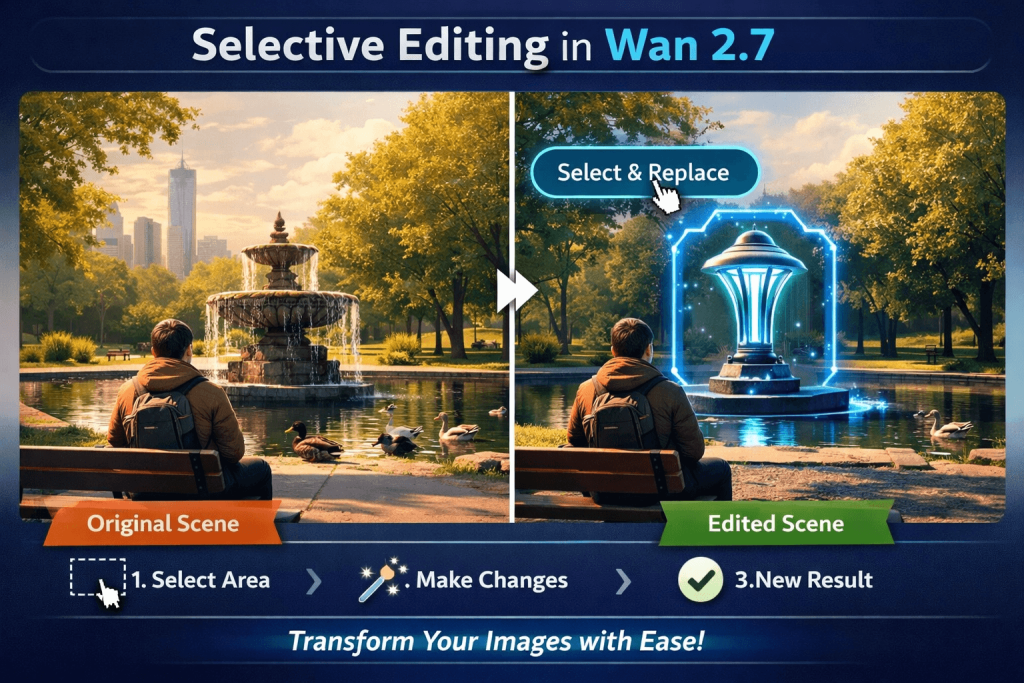
Wan AI is Alibaba’s open-source video generation model, built by the Tongyi Lab and released under an Apache 2.0 license. That licensing detail matters more than it sounds like it should, because it means the core model can be run locally, fine-tuned, or accessed through dozens of third-party platforms and APIs, in addition to Alibaba’s own hosted tools. Wan supports text-to-video, image-to-video, video editing, and increasingly, native audio generation synced to the visuals. Later versions add multi-shot storytelling and a reference-based system for keeping a character’s appearance consistent across separate clips.
What Is Kling AI?
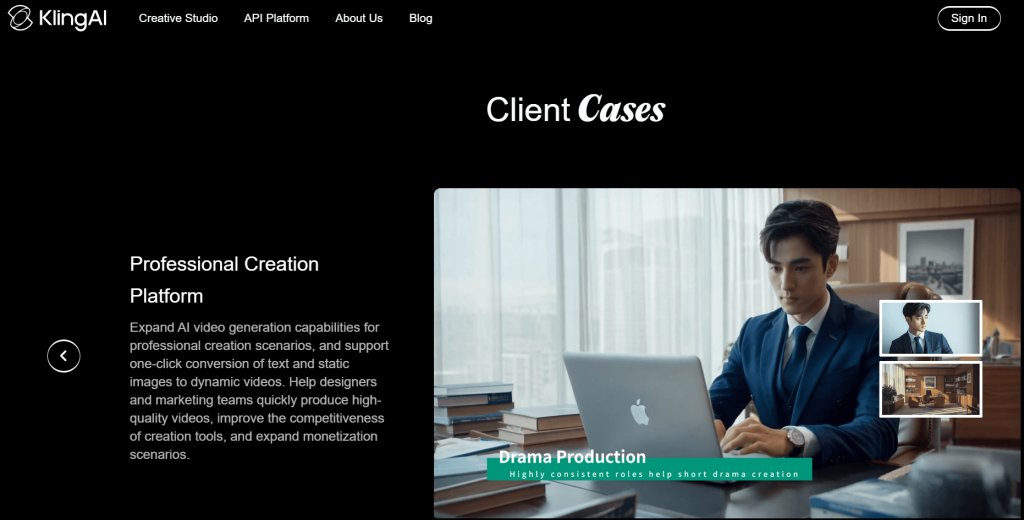
Kling AI is a video generation service from Kuaishou Technology, offered as a closed, credit-based subscription product. It converts text or a source image into short video clips and has built a reputation for cinematic lighting and smooth motion in simple scenes. It’s a generation tool rather than an editing suite, and everything downstream of the clip — trims, captions, sound — still needs another pass.
How We Evaluated Both Tools
The comparison leans on the factors that decide whether a clip is actually usable: prompt accuracy, motion realism, image-to-video reliability, character and scene consistency across multiple generations, credit cost per usable clip, and how much post-processing is required before a clip is publishable. A tool that looks stunning in isolated frames but needs eight attempts to get one clean 5-second shot is not, in practice, the cheaper option.
Wan AI: Strengths and Weaknesses
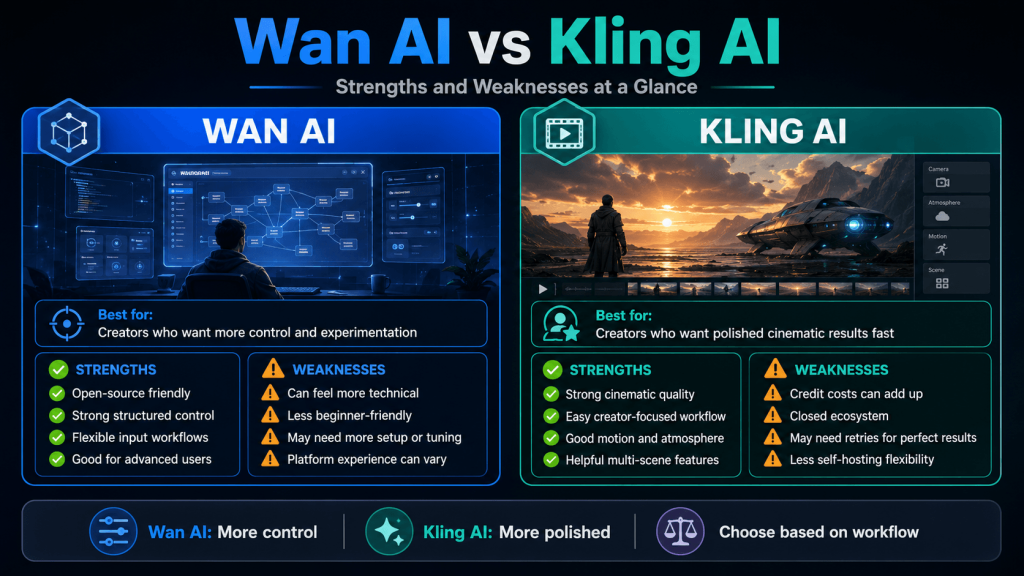
Wan’s biggest structural advantage is that it’s open and inexpensive to run at scale. Because the weights are public, it’s been integrated into a long list of platforms, several of which undercut closed competitors on price per generation. It also benchmarks well against closed models on general video-quality metrics, and its newer releases have pushed hard into features creators actually ask for: keeping a character looking the same across a run of clips, generating synced audio and lip movement instead of leaving that to a separate tool, and building multi-shot sequences rather than isolated single clips.
The tradeoff shows up in polish and predictability. Because Wan is available through so many different hosts, quality and feature sets vary from one platform to the next — the version you get through one API wrapper isn’t guaranteed to match another. Motion in complex, multi-character scenes can still look less controlled than Kling’s best simple-scene output, and getting the most out of the model (longer clips, first/last-frame control, fine editing instructions) depends on which version and which host you’re using.
Kling AI: Strengths and Weaknesses
Kling’s strength is depth of finish in a narrow lane: short, atmosphere-heavy shots with one subject and one clear action. Lighting, depth of field, and camera-like movement in those conditions can look genuinely cinematic straight out of the model. Image-to-video is its most dependable mode, since a source photo anchors the composition far more reliably than a text prompt alone.
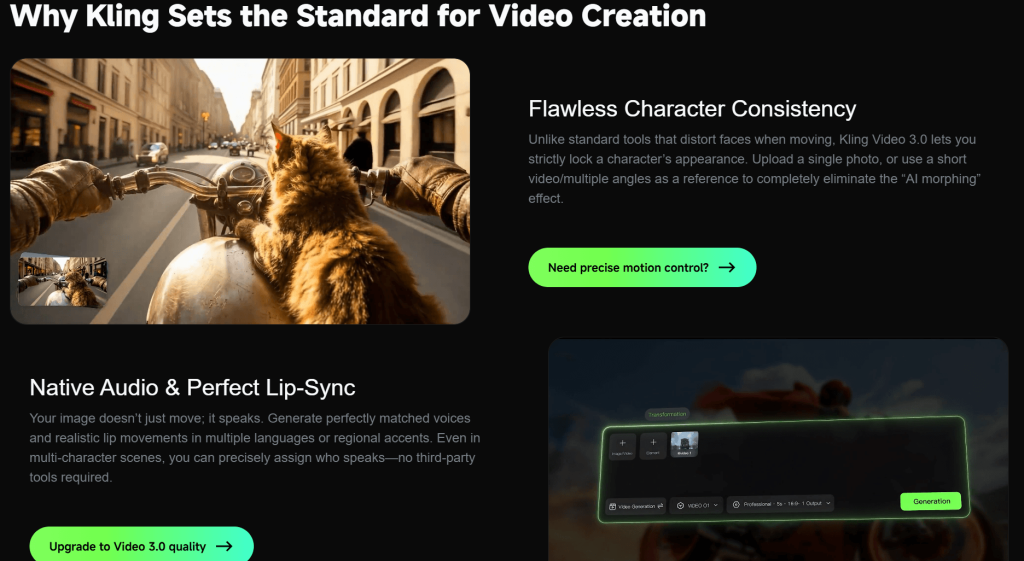
The limitations are the same ones that show up in most single-vendor, closed video models: faces and characters drift across a clip, hands and fine detail distort, and there’s no built-in way to keep a character consistent from one generation to the next. Complex prompts with multiple instructions tend to get partially ignored, and because it’s a closed, credit-metered product, every failed attempt has a direct dollar cost with no local or alternative-host fallback.
Wan AI vs Kling AI: Side-by-Side
| Evaluation Area | Wan AI | Kling AI | What It Means for Creators |
| Access model | Open-source, self-hostable, many API providers | Closed, single-platform, credit subscription | Wan gives pricing and hosting flexibility; Kling gives one consistent experience |
| Text-to-video | Strong, improving fast across versions | Strong for simple, atmospheric shots | Both do well with focused, single-action prompts |
| Image-to-video | Solid and improving | Especially reliable, model’s best mode | Kling edges ahead here for product and portrait anchoring |
| Character consistency | Built-in reference/starring tools in newer versions | Not supported natively | Wan is the better fit for recurring characters or series content |
| Native audio | Increasingly built in (lip sync, ambient sound) | Not a core feature | Wan reduces the need for a separate audio pass |
| Cost per usable clip | Generally lower, varies by host | Higher once retakes are factored in | Wan tends to win on raw cost efficiency |
| Consistency of experience | Varies by which platform/host you use | Uniform, single-vendor experience | Kling is more predictable if you don’t want to shop around |
| Editing readiness | Clip-level output, still needs a production pass | Clip-level output, still needs a production pass | Neither replaces an editing workflow |
Pricing and Credit Value
Kling AI runs on a credit subscription with a free tier to test the workflow before paying. The real cost isn’t the sticker price per generation — it’s how many attempts it takes to land a publishable clip. If a usable result takes three to five runs, the effective cost is three to five times the listed rate, which is the same math that applies to almost every credit-based generator on the market.
Wan AI’s pricing story is different because it isn’t one product. The base model is free and open-source, so cost depends entirely on where you access it: running it locally has no per-generation fee beyond compute, while hosted versions through third-party platforms charge per generation, often at noticeably lower rates than closed competitors. That flexibility is an advantage for creators willing to compare hosts, but it also means “how much does Wan cost” doesn’t have one answer the way “how much does Kling cost” does.
Best Use Cases for Each Tool
Wan AI tends to fit:
- Ongoing content series where the same character needs to reappear across episodes or ads
- Teams that want audio generated alongside video instead of adding it separately
- Budget-conscious creators comparing several hosting platforms for the lowest per-clip cost
- Developers who want to fine-tune or self-host a model rather than depend on one vendor
Kling AI tends to fit:
- Single, polished hero shots for social hooks or campaign concept videos
- Image-to-video work where a clean product or portrait photo needs to move
- Creators who prefer one consistent platform over comparing multiple hosts
- Quick creative prototyping before committing to a fuller production
Pros and Cons
Wan AI
Pros:
- Open-source and often cheaper per generation across hosting options
- Built-in character consistency tools in newer versions
- Native audio generation reduces post-production steps
- Flexible: self-host, fine-tune, or use through many third-party platforms
Cons:
- Quality and features vary depending on which platform or API you use
- Complex, multi-character scenes still show inconsistent motion
- No single, official pricing page since access is distributed across hosts
Kling AI
Pros:
- Strong cinematic lighting and depth in simple scenes
- Image-to-video is more predictable than text-only prompting
- One consistent platform, no need to compare hosts
- Free tier available for testing
Cons:
- No native character consistency across separate clips
- Faces, hands, and fine detail distort under motion
- Closed, credit-metered — every failed attempt has a direct cost
- Complex, multi-instruction prompts are often only partially followed
What Most Comparisons Miss
Most side-by-side reviews compare showreel clips, which tells you almost nothing about a real workflow. The more useful question is how many attempts each tool needs before a clip is actually publishable, and Wan’s open access model changes that math in a way Kling’s closed subscription can’t: if one host’s version underperforms, you can try another without waiting on a single vendor’s roadmap. On the other hand, that same openness means there’s no one “Wan AI experience” to review — the model you get depends on where you run it, which is exactly the kind of inconsistency Kling’s single-platform approach avoids.
Neither tool is a finished production system. Both hand back a raw clip that still needs trimming, review, and — for Kling especially — a separate audio and captioning pass.
FAQ
Is Wan AI free to use?
The core Wan model is open-source, so running it locally or fine-tuning it carries no licensing fee. Most creators instead use it through a hosted platform or API, where pricing varies by provider — generally lower than closed alternatives, but not a single fixed rate.
Is Kling AI free to use?
Kling AI offers a free tier for testing, with paid credit plans beyond that. Because it’s a closed, credit-metered service, the effective cost depends heavily on how many attempts it takes to get a usable clip.
Which tool is better for keeping a character consistent across clips?
Wan AI has an edge here. Newer versions include reference-based tools built specifically to keep a character’s appearance stable across separate generations, something Kling doesn’t offer natively.
Which tool is better for image-to-video work?
Kling AI is generally more predictable for image-to-video, since the source image anchors composition and motion more tightly. Wan’s image-to-video has improved but can vary depending on the hosting platform.
Do either of these tools handle audio?
Wan AI’s newer versions increasingly generate synced audio, including ambient sound and lip movement, as part of the same pass. Kling AI focuses on visuals only, so audio has to be added in a separate step.
Which one should a creator actually pick?
It depends on the workflow more than the model. Creators building recurring characters, watching per-clip cost closely, or wanting audio baked in tend to get more out of Wan AI. Creators who want one predictable platform, strong image-to-video anchoring, and don’t mind a closed subscription tend to prefer Kling AI.
Final Verdict
Wan AI and Kling AI are solving overlapping problems from different directions. Wan’s open-source foundation gives it flexibility on price, hosting, and features like character consistency and native audio — but that same openness means the experience isn’t uniform from one platform to the next. Kling delivers a tighter, more predictable single-vendor experience with genuinely strong image-to-video output, at the cost of being closed, credit-metered, and without built-in consistency tools.
Neither replaces an editing workflow, and neither is a shortcut around iteration. The practical move is the same one that applies to any AI video tool: test both on the actual footage you need to produce, count how many generations it takes to get a clip you’d publish, and let that number — not the showreel — decide where your credits go.