
AI image-to-video tools are quickly becoming popular because users can now transform images into short videos in a matter of seconds. With so many tools coming out, a popular phrase that can be seen on many different websites is “AI image-to-video generator no limit.”
When people immediately see the phrase, they probably assume it means unlimited video generation with no restrictions at all. Things are not that plain. For many websites, the way they use the word “unlimited” varies. Some systems claim to have unlimited generators, but make it so users cannot export the videos. Some websites take away users’ limit for the number of videos they can create in a day , but instead put a watermark on all the videos. Some websites’ tools are free to use, but users can only test the tools in a very small resolution, and the speed at which a video can be generated is extremely slow; people have to generate videos in a highly specific way that is not flexible.
This is why many users learn that “no limit” means very different things based on what the systems are used for. Understanding the variety of the word “no limit” is very helpful because it gives the creators a preference to keep their work with the fewest restrictions.
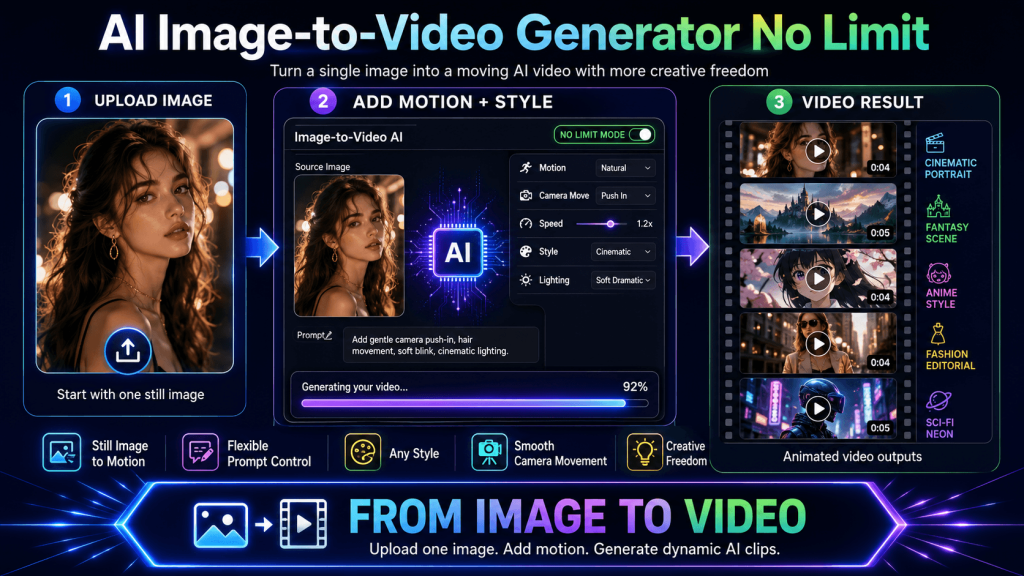
Why the Phrase “No Limit” Has Become Popular
A surge in popularity for AI image-to-video tools has introduced a lot of new customers to ideas centered on fast and easy creativity.
People don’t want to:
- Sit in a queue for the next generation of AI video
- Hit the maximum number of creations in a day
- Make several different accounts to unlock more access to AI
- Put up with heavy restrictions on their accounts
- Pay extra for more features
- Find out that their access to AI has been cut after only a few tries
Phrases like “AI image-to-video generator no limit” grab their attention. People want tools that are open and easy enough to use regularly. The big problem is that the meaning of “unlimited” changes from site to site.
No Daily Limits Does Not Always Mean Unlimited Access
Many think that not having daily limits means no limits at all. Sometimes there are limits on platforms that can restrict users and include five generations per day, free exports, rendering minutes, and even limits on the time that can be used.
When these limits are reached, users have to either wait for the next reset to happen or pay for it. When a tool says “no daily limits,” it means that users are free to keep generating videos and can do so without hitting a daily limit.
Other restrictions remain and can include longer generation time, lower output quality, prioritizing paid users, and restrictions on exports. The experience can still feel limited even if there is technically no daily limit.
Unlimited Trials Are Often Not Truly Unlimited
“Unlimited free trial” and “unlimited testing” are other phrases used in marketing. This is the part many users don’t understand. Some tools let you play around as much as you want, but keep you from:
- HD exports
- Video downloads
- Watermark removal
- Long-duration clips
- Commercial use
There are also cases where users can only generate a final preview once they pay. In a technical sense, the platform has “unlimited” generation. Practically, the experience is very limited.
This is important to understand for creators who need to use a tool and wish to assess it accurately before choosing a paid plan.
No Watermark Is Another Form of “No Limit”
Watermarks can feel like a limitation to many creators, even where the generation is truly unlimited. Some AI video platforms allow an unlimited number of video generations, but put a watermark on video exports. This is a concern for many generations of:
- Client work
- Social media posts
- Portfolio projects
- Commercial projects
- Professional presentations
This is why creators are sometimes willing to find tools that allow the removal of both limits to generation and the watermark.
A platform’s functionality can allow users to create an unlimited number of videos, but if every export contains a visible watermark, many creators still feel limited.
No Sign-Up Is Becoming Increasingly Important
Another meaning of “no limit” means more access. More and more users are complaining about sites that have email verification, account creation, phone verification, payment setup, and subscription registration before users are even allowed to try a single generation. This is an excellent reason to have a no-sign-up AI image-to-video generator. For a lot of creators, the fewer the barriers, the better the creative process.
On top of dealing with accounts, verification, and onboarding, users want the ability to upload images, add prompts, and generate a video. The fewer the distractions, the more natural the workflow.
Prompt Rewriting Is Another Hidden Limitation
Prompt rewriting is the limitation of some systems that many users fail to notice. Some AI image-to-video systems modify the user’s prompt by removing some of the words that describe what they want, softening the details of what the users want, reducing the intensity of the movement the user wants, simplifying scene instructions, and filtering stylistic language.
As a result of this, users receive the output that is a watered-down version of what they have asked for. This is the reason some creators use the term “no limit” to refer to the maintenance of prompt systems.
They are not necessarily asking for systems with no controls or no safety measures, but they are asking for systems that are able to retain more of the user’s prompt without modifying it too much.
For a lot of creators, the ability to predict the results is more valued than the ability to use the systems without limits.
Paid Credits Often Replace Traditional Limits
You may have noticed that more and more AI video tools are doing away with hard limits that define how many video outputs you can do per day. Instead, they are turning to credits. Under this model, each generation costs credits; videos that are longer cost more credits, exports in HD cost extra credits, and outputs in advanced settings cost more credits.
This makes it more flexible for the tools, but many users believe it also creates an experience that is more uncertain. A creator that pays for a subscription may believe that they now have a way to create an unlimited number of generations, only to find out that credits can run out really quickly, prompt costs can get costly, high-quality rendering may cost credits, and certain rendering features are saved for the premium tiers.
More of these experiences of creators paying for a service and believing they are now able to utilize a once premium feature for free foreshadow a mass of creators carefully reviewing the pricing scheme before selecting a tool. The term ‘unlimited’ has much less meaning to users if they are only able to use features by paying with credit.
Export Limits Can Completely Change the Experience
Another limitation is the export quality and time. With some platforms, people are able to create unlimited generations but limit the resolution of the video, the quality of what is exported, frame rate, the time limit of how long the clip is, and when people are able to download the video.
An example of how people are limited is that they are given a preview that is a lower resolution, a clip that is only 3 seconds, a video that is of a lower quality, and limited options on what the video can look like unless they upgrade to a better plan.
They only discover these constraints after they have spent the majority of their time and efforts on creating a video. From the perspective of the person creating the video, the quality of the generation is not that important because the final export is made useless.
Why Users Are Becoming More Selective
As AI video tools become more common, creators are becoming more skilled with how platforms work. Users no longer react to incentive statements but instead react by evaluating the friction of their workflow, how consistent the generation is, the accuracy of the prompts, how privacy is managed, the freedom of the export, the policy for watermarks, the requirements of accounts, and the usability.
This is a major development. In order for tools to have a competitive advantage, they should provide a reasonable return for time spent, limit the number of obstacles that their users experience, offer outputs that are easily understandable, and be clear about what features they restrict. When a tool is unobtrusive in how it is used, that is an indicator of strong user retention.
What “Unlimited” Should Ideally Mean
Infinite free access isn’t what most creators want for the best AI image-to-video experience. Actually, creators wish for fewer disruptions, less ambiguous restrictions, uniformity in behavioral response to prompts, affordable payment plans, direct and clear access, more autonomy to manage exports, and smoother workflows.
Creators value usability and practicality more than marketing strategies; limitations don’t need to be entirely removed for a workflow to be optimized. The goal is not to have a complicated creative process.
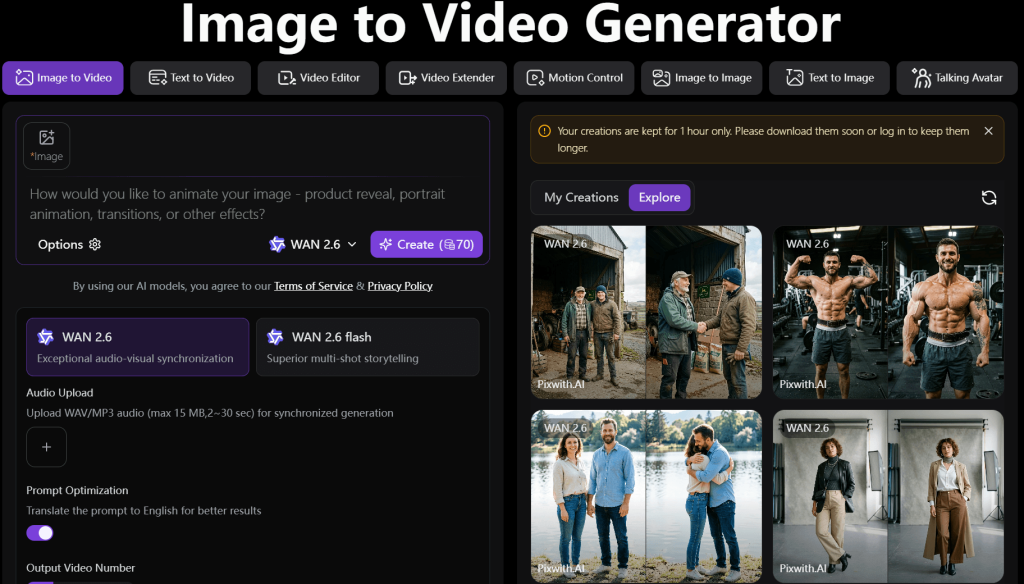
Where Tools Like Pixwith Fit In
Some AI systems fill the gaps with multiple advanced and layered restriction systems. Compared to others, Pixwith’s goal is a more seamless image-to-video process, and because of this, many choose Pixwith. Many appreciate a balance in simplicity versus ‘unlimited’ marketing.
Tools with accessibility, speedy generation, less complexity, fewer interruptions in the flow of work, a creation process that is clear and direct, and workflows that are more reliable, in practice, matter more than any marketing claim.
Conclusion
“AI image-to-video generator no limit” appears somewhat simple, but it can mean many different things depending on the site. Some will take away your limit on how many files can be exported per day, but you will still have a limit on how many files you can export at all. Others will give you unlimited previews of how your video will look, but not in HD unless you pay for it. Some will go to the other end of the spectrum and give you no limits on anything whatsoever but will watermark your video, or charge you for it, or moderate what you say. This is where looking into what’s actually meant by “unlimited” comes in handy.
Most creators are not looking for an absolutely no-limit experience but a way to sharpen the tools that they use, without all the extra work around the tool’s limitations slowing down their creative flow and work. As users learn more about AI video generation, these aspects are becoming more important than what the creators of these tools say.
For users who prefer a more direct image-to-video creator with fewer workarounds, Pixwith is the right tool. They make a much simpler and readily available way for you to create AI videos.