
One of the fastest-growing fields in generative technology is AI video generation. What required advanced software, tools, and skills is now done with AI-powered tools in minutes. Now, users can upload images, write a prompt, and generate their preferred animated videos in seconds.
However, the more accessible these tools become, the more issues they cause. One of the recent issues that’s common online revolves around “uncensored AI video generator.”
On the surface, the phrase sounds controversial, whereby most people associate it with explicit videos, whereas it’s not limited to that.
In fact, according to a study, a major percentage of people are not searching for an uncensored AI video generator for their illegal use. They are simply fed up with overly aggressive systems, hidden prompt rewriting, and tools that interrupt creative workflows even when the content is harmless.
There’s a difference between creative freedom and irresponsible or harmful AI content creation. Understanding this is crucial as AI video tools keep evolving.
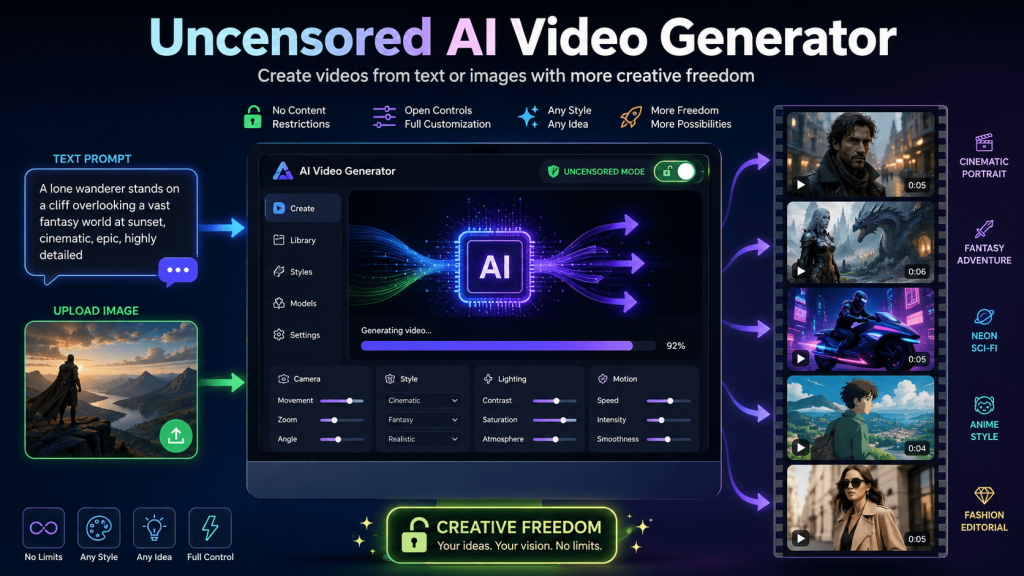
What Does “Uncensored AI Video Generator” Actually Mean?
The phrase “uncensored AI video generator” is a bit of a marketing gimmick. This causes some confusion.
As far as users are concerned, “uncensored” just means:
- Fewer restrictions on what users can type
- Weaker filters and less aggressive filtering
- More creativity
- Less annoying interruptions in the workflow
- Greater integrity of prompts
Users are likely not looking for the prompt to be lawless, nor are they looking for dangerous tools. They are simply looking for a tool that helps them do creative work without the tool blocking everything they do.
Users are extremely frustrated because of what is sometimes called:
- Artistic prompts incorrectly flagged as NSFW
- Fantasy prompts rejected
- Blocked animations of a character
- Prompts rewritten with no liberty
- No moderation to harmless visual prompts
This is a major reason behind the growing popularity of the search term.
Sure, the search vocabulary could be easily altered for a greater purpose, but there is a legitimate fear of misuse of “uncensored” tools. With every new tool, the emphasis on responsible AI video creation design needs to be there.
Responsible AI Video Creation Is Not the Same as Heavy Restriction
Another idea constantly misperceived in regard to AI discussion is the idea that responsibility automatically means excessive censorship. Responsible AI video creation design is about the “boundaries” and not the “creativity.”
In an ideal situation, a responsible tool would:
- Support all legitimate creative endeavors
- Provide privacy to the user
- Keep the system safe from bad actors
- Establish legal and ethical norms
No one is trying to kill creativity. The main objective is to prevent AI design tools from using creativity in a way that’s directly harmful to other people.
When moderation systems block harmless prompts from users, while the harmful prompts bypass other moderation systems, users become more frustrated.
This kind of inconsistency helps build distrust.
Why Consent Matters in AI Video Creation
The case of consent is important, particularly concerning AI-generated content. This kind of technology can be both exciting and useful in various collaborations, but real-life representations can be highly unethical.
Crossing ethical boundaries by using something to create misleading or suggestive content without the owner’s permission is crossing an ethical boundary. This is why the following behaviors are all considered unethical and are prohibited by different content hosting services:
- Impersonating someone
- Making deepfakes
- Misrepresenting someone’s identity
- Creating nonconsensual synthetic media
This is what upholds the value of creative freedom. Privacy, consent, and identity protection also fall in the domain of creative freedom.
The Role of Synthetic Content Labeling
AI has become an impressive technology. Many modern AI simulators can create hyper-realistic depictions of people, making videos nearly indistinguishable from real life.
Some content hosting services are starting to require labels for content that is non-simulated. When a clip appears animated, some services require Pops to announce that the content is AI-generated.
This will not inhibit creativity, but rather aid users by creating an ethical environment and decreasing:
- Altered images
- False media
- Misinformation
- Misleading content
Finally, this is especially important for the following people and places:
- Anyone in the news
- People in the political spotlight
- Any public figure
- Controversial posts on social media
Without transparency, viewers may struggle to understand whether what they are watching is real or AI-generated.
Privacy Concerns Are Becoming a Bigger Issue
Privacy is also crucial in creating responsible AI videos. Many AI apps require the user to submit private images, creative ideas, or private documents to a cloud-based system. Naturally, the user wants to know what happens to that data and documents after they are generated.
There are many issues to consider, such as:
- Do they upload and save documents permanently
- Do they save the prompts
- Is the generated content used to train the model
- Can the user delete the uploaded documents
- Is the user’s activity monitored in other accounts
This is one of the reasons many users now prefer systems that rely on direct workflows and clear privacy guidelines. Even users who want fewer creative constraints still consider the ways in which their private data is protected. Users of the apps have shown that privacy and creative freedom are not unconcerned opposites. They are closely related.
Copyright Still Applies to AI-Generated Content
Another misconception surrounding uncensored AI video generation is that the content generated must still be subjected to the creative rules of copyright. This is not correct:
Even with AI, users must consider the following:
- Copyrighted characters
- Licensed footage
- Registered trademarks
- Ownership-based commercial interests
- Intellectual property concerns
Even the video generation tool does not remove the loss of the user’s rights to their creative content.
As AI tools become more commercially applied, it will be essential to continue the current copyright and intellectual property rights debates.
Why Platforms Use Moderation Systems
A lot of people get mad at moderation systems because they can feel inconsistent or overly harsh. Yet, moderation systems are implemented for several reasons:
- Legal compliance
- Abuse prevention
- Age-appropriate safety standards
- Platform reputation
- Protection against harmful misuse
Moderation systems are not the problem. The focus should be on how moderation systems are implemented. When harmless prompts are blocked without an explanation, users will not trust the system. Platforms need moderation systems to prevent the misuse of the system. Striking a balance between protecting users and allowing creativity is where most AI systems are struggling.
Creative Freedom vs. Harmful Misuse
This is where most of the systems start to become clearer. Creative freedom consists of more artistic and playful activities and inclinations like:
- Artistic experimentation
- Storytelling
- Stylized animation
- Fictional concepts
- Visual creativity
- Entertainment projects
On the other hand, harmful misuse includes:
- Non-consensual content
- Deep fakes
- Identity theft
- Exploitative material
- Manipulative and unethical synthetic media
Unfortunately, most internet users tend to confuse the two ends of the spectrum and create extremism where every flexibility in creativity is viewed as a potentially harmful misuse.
In the end, users just want systems that will:
- Preserve system integrity
- Avoid unnecessary limitations
- Keep user privacy
- Maintain a predictable monotony
What Users Should Look for in an AI Video Tool
AI video tools are becoming popular, and when it comes to picking these tools, users are becoming more picky. Because of this, many elements of the tools become important to users, like:
- Consistency in moderation
- Whether prompts are altered silently
- Privacy policies transparency
- Freedom to manage and remove their uploads from the platform
- Consistency of the user’s overall experience on the platform
- Users’ freedom to create whatever they want
Trust is becoming just as important as output quality. AI tools are supposed to be useful. However, users will not pick tools that are not fair, transparent, and consistent.
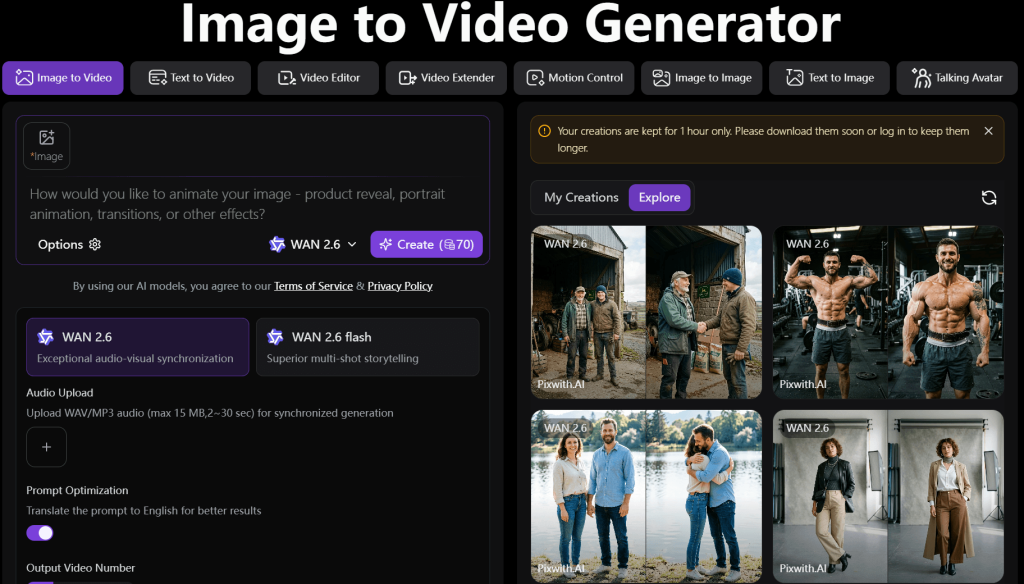
Where Tools Like Pixwith Fit In
Not all users want people to freely create without restrictions, nor do they want systems that are tightly controlled. They want some of both, the flexibility to be creative and the responsibility not to be too extreme. That’s why Pixwith is popular. It’s meant to be useful to many creators.
There is a direct way to create videos, and that is the goal Pixwith created the tool in the most straightforward, low-friction way to be creative, and still use the tool mindfully. This tool strikes the right balance in the eyes of users.
They want the freedom to use the tool in a creative way, without unnecessary disruptions, and they also want the tool to be trustworthy, protect their privacy, and use creativity responsibly.
Conclusion
Discussions on AI video generators that lack censorship have more layers than they initially display. Most people do not want a total absence of regulations. What they prefer is a solution that minimizes restrictions on creative expression, inconsistent application of rules, and disruptions of the creative flow.
Responsible AI video creation does warrant concern. As AI technologies evolve, the need for consent and privacy, transparency of synthetic content, and cognizance of copyright and age restrictions, will be a necessity. AI video creation will be successful to the degree that users feel they have the tools to create without having to compromise on ethics, trust, and transparency.
To users more concerned with a smooth and properly regulated workflow, Pixwith is a practical utility for private and responsible AI video creation.