
Many creators are displeased with highly restrictive tools because every generation attempt is more like a gamble. The workflow of such tools is constrained, the system interferes with the process, and users cannot even express their ideas raw and clearly.
However, there are “no restrictions video generators” that are frictionless (i.e., they do not slow down workflows or break the creative momentum). And in image-to-video generation, where the goal is not just to create visually appealing results, but to bring a specific idea to life with accuracy and control, this is significant. When prompts are restricted or outputs become unpredictable, that control is lost.
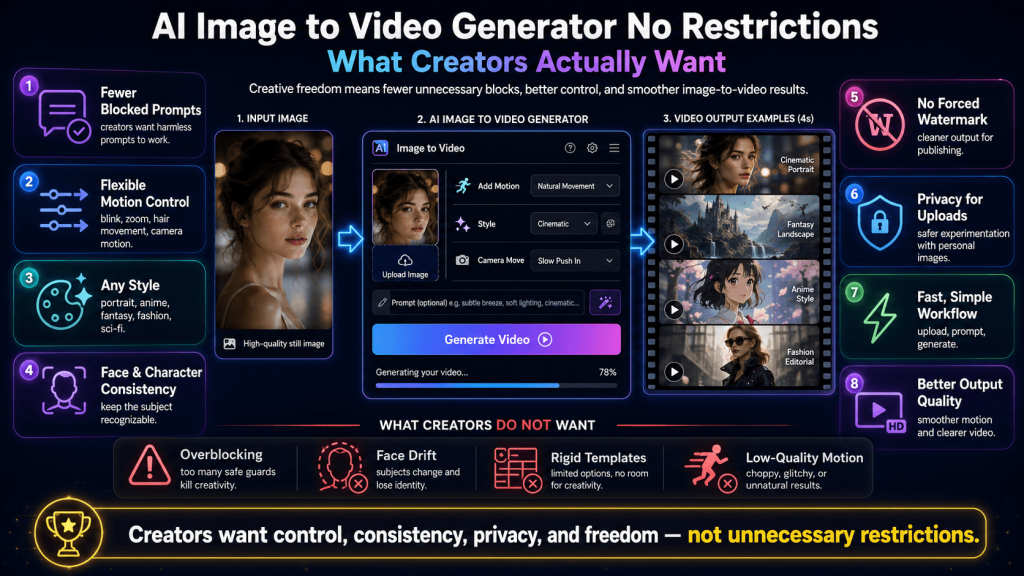
What “No Restrictions” Really Means in AI Image-to-Video
Creators are usually not asking for a completely unregulated system, but for one where there is no friction and no unnecessary or unpredictable interference with the creative process. Basically, “no restrictions” is practical and workflow-driven.
At its core, the idea revolves around freedom of execution rather than freedom of content. For most creators, the challenge is not in generating ideas but in having those ideas translated accurately into motion. Therefore, it becomes a concern when the AI image-to-video generator filters, rewrites, or simplifies prompts and inputs. A creator might describe a specific scene with clear intent (i.e., camera movement, subject motion, and atmosphere) only for the output to reflect a portion of that vision. In some cases, the prompts are rejected altogether, creating a disconnect between input and output.
This is why it is important to distinguish content freedom from workflow freedom. Content freedom is about what can or cannot be generated, while workflow freedom is about how smoothly a creator can move from idea to result. In the context of image-to-video, however, workflow freedom matters far more. Creators should be able to write prompts naturally, without second-guessing which words might trigger a filter. In short, a smoother, more predictable, and more responsive creative experience.
Overall, the phrase “no restrictions” is all about restoring control. It reflects a demand for generators that respect the creator’s input, a system that will preserve the integrity of the original image, and a workflow where ideas can be expressed with no unnecessary interference.
Prompt Restrictions vs. Credit Restrictions: The Hidden Bottlenecks
Restrictions in AI image-to-video generators are commonly about blocked prompts or content limitations, but they are crucial to how usable a tool is. And together, they can limit creativity and productivity more than most users expect.
Prompt restriction is when a generator rejects a request, rewrites it, or ignores certain parts of it. In reality, some filtering systems are overly sensitive, and they sometimes flag harmless words and misinterpret context, leaving creators to work around prompts just to get past the system.
More so, prompt restrictions often lead to a loss of creative intent whereby the final output no longer reflects the creator’s original vision. In image-to-video generation, where the goal is to animate specific details, this forces creators to start over.
In contrast, credit restrictions are less visible but equally impactful. Many AI generators operate on a pay-per-generation model, where each attempt consumes credits. However, if it takes multiple tries to get a usable result, and each failed attempt costs credits, then experimentation becomes expensive. Therefore, creators are pushed into a more cautious approach of trying to “get it right” in as few attempts as possible.
By implication, users may limit themselves to safer, simpler prompts, instead of iterating and refining, which is a natural part of any creative process. The outcome is not just fewer experiments, but also lower-quality results.
Together, the effect of prompt restriction and credit restriction in a creative workflow is compounded. A prompt might be partially blocked or misinterpreted, leading to a poor result, and then that failed attempt still consumes credits. The creator pays for something that did not work, and then has to try again under the same constraints.
This is why restrictions are not just a content issue—they are also a productivity issue. They determine how fast and accurately ideas can be executed, and how confidently creators can work within the generator.
Style Restrictions vs. Content Restrictions: Where Tools Fall Short
Content restrictions are the rules that determine what a tool will or will not generate. In theory, they are meant to limit harmful or inappropriate outputs. In practice, however, harmless prompts can be blocked simply because certain words are flagged out of context, or because the system misinterprets the intent. This inevitably leads to situations where creators are not able to predict the workflow or rely on the generator.
Style restrictions, however, are more subtle but often more dissatisfying. These occur when a generator limits appearance. From a firsthand viewpoint, many AI generators clearly have a default aesthetic. Therefore, when prompts aim for distinct styles (e.g., anime, fantasy art, or highly stylized character designs), the results may be dissatisfying.
It is also worth noting that in image-to-video workflows, where the creator starts with a specific image, the style, composition, and visual identity of the character are already defined. Therefore, altering the colours, reshaping the characters, tweaking the overall tone, or introducing stylistic changes during animation breaks continuity and defeats the purpose of using an original image as base.
Moreover, style freedom is usually underestimated. However, it affects branding, because consistent visuals are essential for recognition. It affects storytelling because the tone of a scene is closely tied to its style, which also affects audience engagement. When style is restricted in an image-to-video generator, all of these areas are impacted.
In this context, “no restrictions” addresses how accurately and authentically AI videos can be generated. For many creators, having control over style is just as important as having freedom over content.
What a True “No-Restriction” Workflow Should Allow
A no-restriction AI image-to-video workflow is one whereby ideas can be transformed naturally, without unnecessary resistance at each step.
At the centre of this is control over the creative process. A good workflow should allow creators to describe motion, camera behaviour, and visual style directly and intuitively. When a prompt specifies a slow camera pan, subtle character movement, or a particular atmosphere, the output should reflect that intent as closely as possible. This level of responsiveness is what turns AI from a novelty into a usable tool.
In addition, in image-to-video generation, the starting point is already defined by the original image, which means the AI’s role is to animate, not reinterpret. Therefore, a reliable workflow should preserve the structure, identity, and composition of the source image while introducing motion.
Moreover, creators need their generator and its outputs to be predictable across multiple generations. This does not mean every result should look identical, but there should be enough stability so that the ideas can be further refined. More so, it will be difficult to build anything beyond isolated clips if each attempt produces completely different results.
A no-restriction workflow should allow creators to move quickly from one version to the next without excessive trial and error — speed and iteration. Without this, even a powerful generator becomes inefficient in real use.
Even so, there is also a practical expectation around output quality and usability because clean exports, with no forced watermarks or branding overlays, are essential for anyone creating content for public use, whether for social media, client work, or personal projects.
The Tradeoff: Why Most Tools Still Have Restrictions
AI platforms are designed to operate at scale and serve a wide range of users across different regions and use cases. To manage this, their developers implement filtering and moderation layers that attempt to prevent misuse —safety. While the intention is reasonable, these systems are often overly cautious, and they rely on pattern detection rather than understanding the full context. This creates a situation whereby the generators prioritize risk avoidance over creative flexibility.
In addition, image-to-video generation is still an evolving technology, and maintaining consistency across frames is a complex challenge. To compensate for this drawback, many tools impose hidden constraints to regulate outputs. In other words, the restrictions are sometimes built into the model not just for safety, but to stabilize performance, even if that means reducing user control.
Most importantly, it requires a substantial degree of computational resources to transform images into videos, and it costs even more when aiming for high-quality results. Hence, the reliance on credit-based systems to control generation attempts or iterations. From a business perspective, this helps manage infrastructure costs. From a creator’s perspective, however, it is unsustainable.
Nevertheless, creators are better off using a generator whose system does not interfere with their creative process.
What Should Still Be Restricted (Responsible Use Matters)
AI image-to-video generators are a part of a broader digital ecosystem. Therefore, certain boundaries are necessary.
Any system that allows completely unrestricted generation without safeguards would indubitably become unsafe to use and difficult to maintain. This includes content that promotes harm, exploitation, or activities that violate laws. Responsible platforms are, however, expected to prevent these use cases, and most creators understand and accept this as a baseline requirement.
Even so, as AI becomes more capable of generating realistic visuals, the risk of impersonation or unauthorized representation increases. Ethical boundaries, however, prevent the technology from being abused and also safeguard identity.
In essence, some restrictions, when applied thoughtfully, can protect users, their data, and privacy, without disrupting their workflow.
Closing Thoughts
Creators are no longer satisfied with features alone, but with how the features translate into a smooth and reliable workflow. An AI image-to-video generator that blocks prompts, limits styles, or produces unpredictable results is unreliable in real-world use.