
When it comes to the world of generative AI, one of the leading tools is the AI image-to-video tools. The reason for this is the powerful and evolving results these tools provide. Designers, marketers, creators, and even storytellers are now finding more interest in these tools due to their ability to provide a creative workflow in minutes. As a result, the search behavior has seen a recent trend, which is users actively searching for an NSFW AI image-to-video generator alternative.
Tired of Expensive NSFW AI Alternatives
More Control, Faster Output, And Fewer Creative Limits.
Try Now
In reality, the search term doesn’t necessarily mean what it looks like. Instead, users are looking for platforms that either offer fewer restrictions on creative expression, better privacy handling of uploads, higher-quality motion output, faster rendering times, or less friction (no sign-ups, fewer paywalls, fewer limits). In summary, the search intent is not “NSFW tools,” but AI video tools that allow freedom in the way of creation.
Hence, this guide will explore the best alternatives available in the market today. Not only that, but also a comparison between certain tools, why people are switching platforms, and what you should consider when choosing a tool.
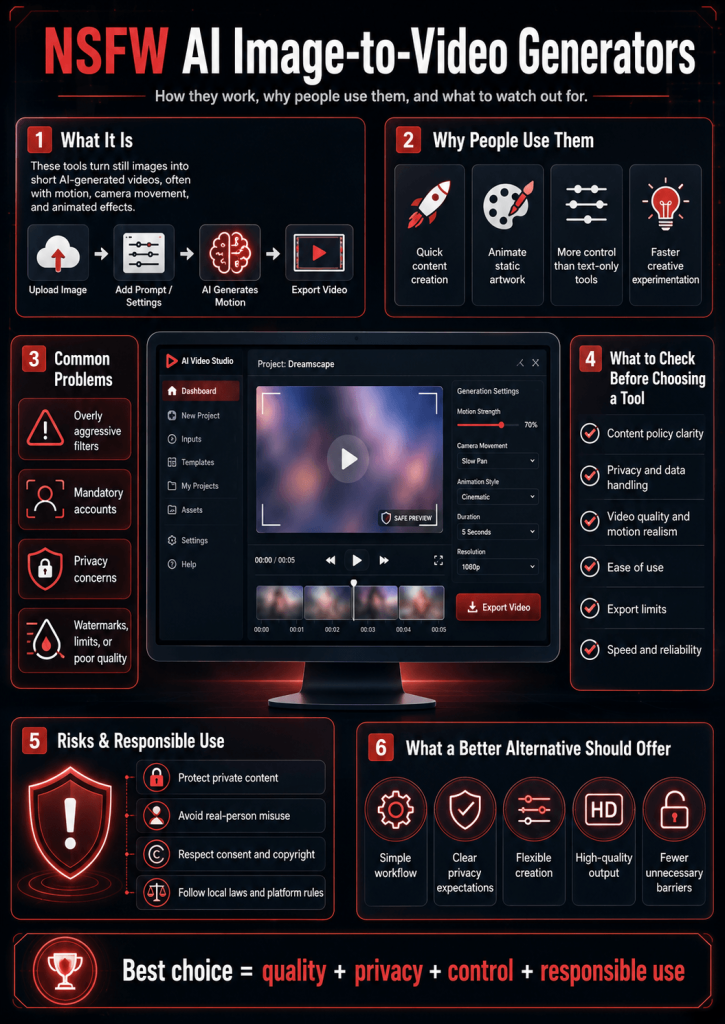
What does NSFW AI Image-to-Video Generator mean?
An NSFW AI Image-to-video generator is an AI tool that has the ability to turn still images into animated video clips and allows “NSFW” (“Not Safe For Work”) content.
These tools make use of generative AI models to create motions, facial expressions, camera movements, and even animation from an uploaded still image.
In most cases, you upload an image, and the AI adds motion and turns it into a short video.
Why do People Search for NSFW AI Image-to-Video Alternatives?
The main reasons users search for these alternative tools are:
Over-restriction of creative tools
One of the issues users experience with many mainstream AI platforms present today revolves around their unusually strict filters. Even when users are working on fantasy art, stylized character animation, concept visuals, and storytelling scenes, these filters tend to prevent them.
Lack of control over outputs
Another complaint is users’ lack of control. While users prefer motion control, they usually get automated results like random animations, inconsistent movement, unnatural facial or object motion. As a result, users are looking for alternatives that provide more predictable results.
Privacy uncertainty
Another uncertainty is a lack of trust. Users value privacy and don’t want their uploaded images to be stored indefinitely, reused, or shared across systems. Even though companies claim to provide privacy protection, users are seen to prefer simple tools that have few data layers.
Performance bottlenecks
Many platforms present today offer slow rendering queues, server congestion, and limited free usage. Hence, users are looking for alternatives that are free of these problems and produce faster and lighter performance.
What Makes a Good AI Image-to-Video Tool?
When it comes to good AI image-to-video tools, there are certain factors they should possess. Below are the top ones you should know about:
Natural motion quality
Nothing ruins a good tool more than a bad motion. Good tools usually keep the image stable while adding smooth, natural motion without flickering or distortion..
Speed vs quality balance
Another factor that makes a good tool is the speed and the quality balance. While some tools offer super speed and provide low quality, some offer speed and high quality. As a result, a good tool will ensure short clips are generated quickly, quality does not degrade significantly, and simple outputs do not take long to generate.
Ease of use
Nothing interests one more than simplicity when using a tool. A good AI image-to-video tool should not be difficult to use. A simple option to upload an image, choose settings, and generate a video is enough.
Reliability
While creators fancy good results, a considerable number of them want repeatable results. That is, a tool that gives you good results once but fails the next time isn’t very useful in practice.
Privacy clarity
Privacy is also another thing a good tool provides. Images users upload should not be stored, nor used for training. In fact, users should be able to delete them after uploading them. When users know their uploads aren’t being stored or reused, it immediately makes the tool feel more trustworthy. .
Best NSFW AI Image-to-Video Generator Alternatives
Here we will bring to you the top 5 best NSFW AI Image-to-video generators. They are:
1. Runway ML
This is one of the most renowned AI video generation tools in the market today. Most creative and experimental filmmaking industries use it.
Pros
- Well-polished AI-generated videos
- Stable motion quality
- Strong model development backup
- Advanced editing tools
- Multiple generation modes
- Professional-level output control
Cons
- Requires account setup and login
- Credit-based usage can feel restrictive
- Moderation filters can block certain creative directions
- Advanced features are locked behind subscription tiers
Overall Impression
Runaway ML is a strong tool, but it gives the appearance of a professional studio tool instead of a simple creative generator.
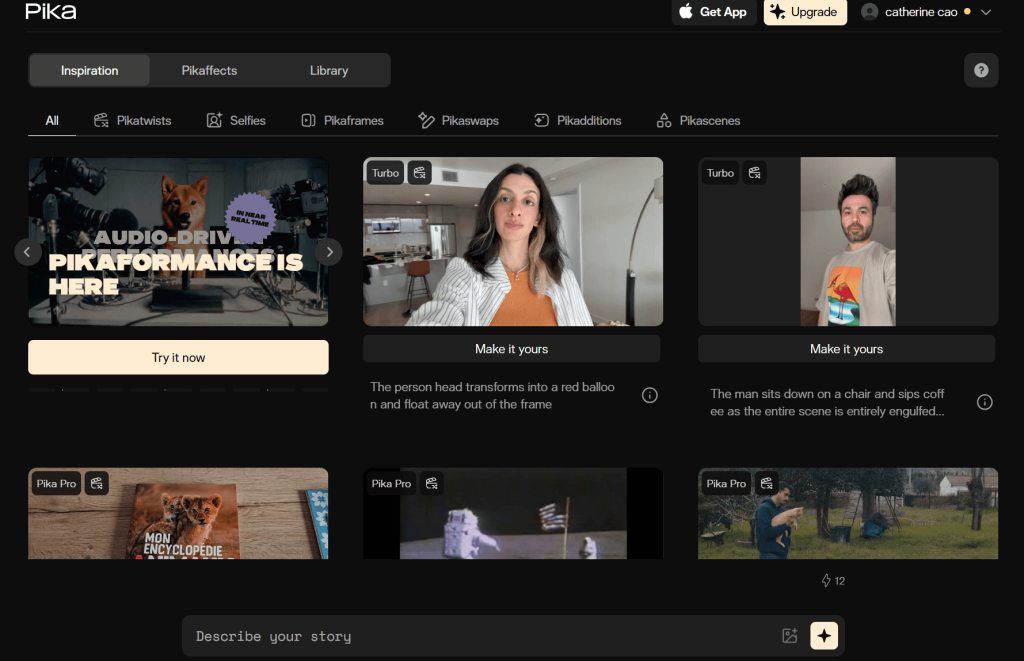
2. Pika Labs
Pika Labs is another tool that has become prominent due to its flexibility over traditional AI video platforms.
Pros
- Beginner-friendly interface
- Quick generation pace
- Solid community adoption
- Adequate animation quality for short clips
Cons
- Varying output consistency
- Limited deep customization
- Prompt type restrictions
- Unstable platform
Overall Impression
When it comes to experimentation, Pika comes number one, but it is not reliable as it lacks consistency when it comes to producing consistent work.
3. Kaiber AI
Kaiber is another AI video generation tool that is more of an artistic transformation tool rather than a realistic motion tool.
Pros
- Appealing visual transitions
- Excellent for abstract storytelling
- Perfect for music visuals and creative projects
- Suited for music visuals and creative projects
Cons
Reduced realistic motion control
Reduced processing in peak times
Requires subscription for full functionality
Artificially stylized feeling
Overall Impression
If realism is not the goal, Kaiber is more suited as a tool than any other.
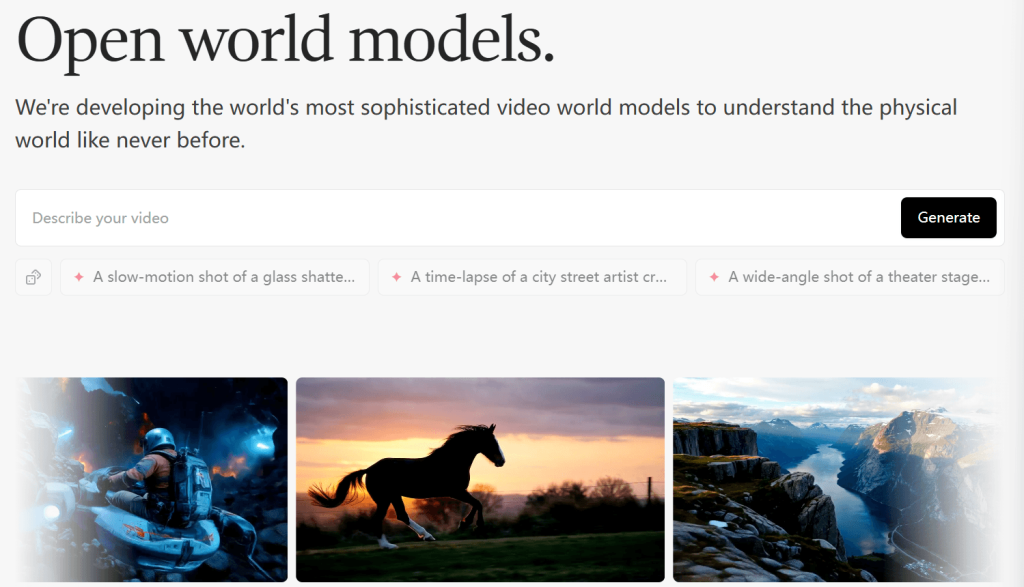
4. Genmo AI
Genmo is a developing tool, yet it has gained popularity among early users.
Pros
- Flexibility in input options
- Freedom in creativity
- Growing model capabilities
- Experimental features
Cons
- Output quality inconsistency
- Ongoing active development’
- Inconsistent reliability
- Absence of advanced editing control
Overall Impression
Genmo is a non-fully developed tool. Even though promising, the tool still shows instability.
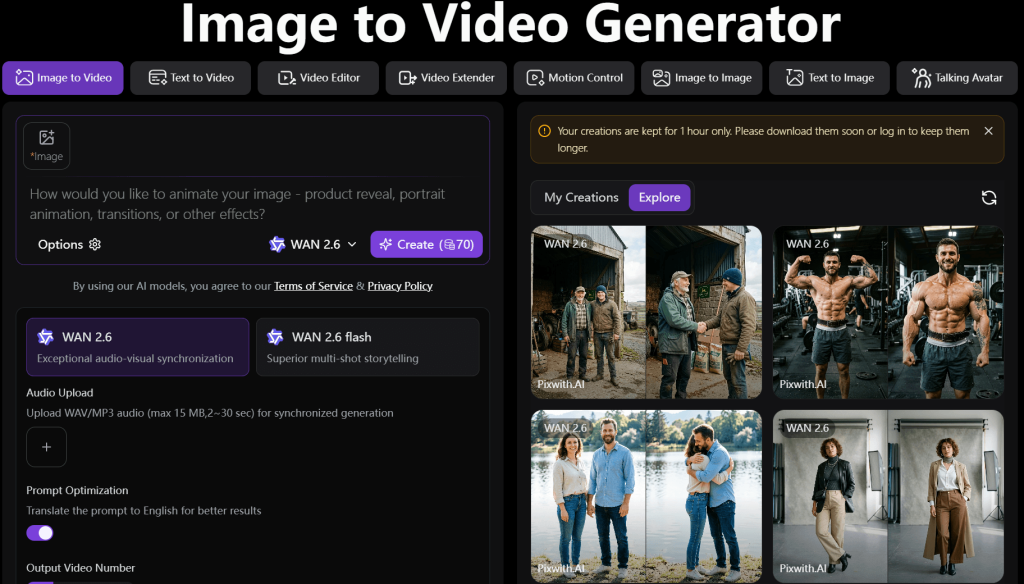
5. Pixwith.ai (Simple Alternative for Everyday Use)
Compared to all other AI video generation tools out there, Pixwith.ai is the tool we found user-ready the most. After a careful review, most platforms are seen to be either complex, restrictive, or unreliable, and that’s not the case for Pixwith.ai. Instead of appearing advanced to users, this tool positions itself differently by focusing on “fast and easy image-to-video generation without unnecessary complexity.”
Why Choose Pixwith.ai
- Easy-to-use interface
- Minimal learning curve
- Fast image-to-video conversion
- Few workflow steps
- Result focused
- Easy accessibility for beginners
- Lightweight and practical
Where is it most useful?
- Swift creative testing
- Easy animation generation
- Speed is needed over advanced control
- Lightweight software system
In a saturated space filled with heavy platforms,Pixwith.ai maintains simplicity and is recommended as the best NSFW AI image-to-video generator alternative for everyday use.
Which Tool Should You Actually Use?
We won’t be biased. Different tools have their distinct strong points, and the right one depends strongly on your priorities. Below are what you should know:
- For professional production → Runway ML
- For fast experimentation → Pika Labs
- For stylized visuals → Kaiber AI
- For experimental workflows → Genmo AI
- For simple and fast results → Pixwith.ai
One thing that is seen is that most creators combine more than one tool rather than depending on one.
Conclusion
As we have earlier referenced, the search intent is primarily more than what we can see on the surface. While users want more control, fewer barriers, quicker workflows, and more reliable creative tools, it is more important now than ever for every tool to maintain simplicity.
While most platforms focus more on complexity, Pixwith.ai advertises simplicity and reliable results. As a result, it has become a practical alternative for everyday creative work. Ready to turn images into videos without the complexity? Try Pixwith.ai for fast, simple, and privacy-focused AI video generation.